** This session may be vulnerable to “store now, decrypt later” attacks.
Sulfurized isobutylene (SIB) is technically a type of sulfurized olefin — isobutylene is itself an olefin, so SIB is the isobutylene-derived branch of the same sulfur-carrier family. What actually separates two candidate grades on your bench isn’t the family name; it’s three numbers on the TDS: total sulfur %, ASTM D130 copper-corrosion class, and color. And those three numbers don’t always move the way you’d expect.
This comparison is written for formulation engineers choosing between EP sulfur-carrier grades for gear oil or metalworking-fluid packages — not as a general introduction to extreme-pressure additives (see the EP additives hub for that).
Same Family, Different Carbon Backbone
Both sulfurized isobutylene (SIB) and sulfurized olefin are sulfur carriers: molecules that hold sulfur in active polysulfide (–Sx–) bridges and release it at the hot, loaded metal contact to form a sacrificial iron-sulfide film. SIB is made from isobutylene, a short-chain olefin, sulfurized under high pressure. When suppliers sell a product simply labeled “sulfurized olefin” — like CheMost’s T2040 — it’s usually built on a different olefin backbone than isobutylene, tuned for a different job (metalworking fluids rather than gear-oil EP duty).
So this “vs” is two carrier structures inside one family, not two unrelated chemistries — and carrier structure is what drives the numbers below.
The Numbers: Sulfur %, Copper Corrosion, Color
Here are the two CheMost grades side by side, taken directly from each product’s technical data sheet:
| Property | CheMost-T321 (SIB) | CheMost-T2040 (Sulfurized Olefin) |
|---|---|---|
| CAS No. | 68511-50-2 | Not disclosed on TDS |
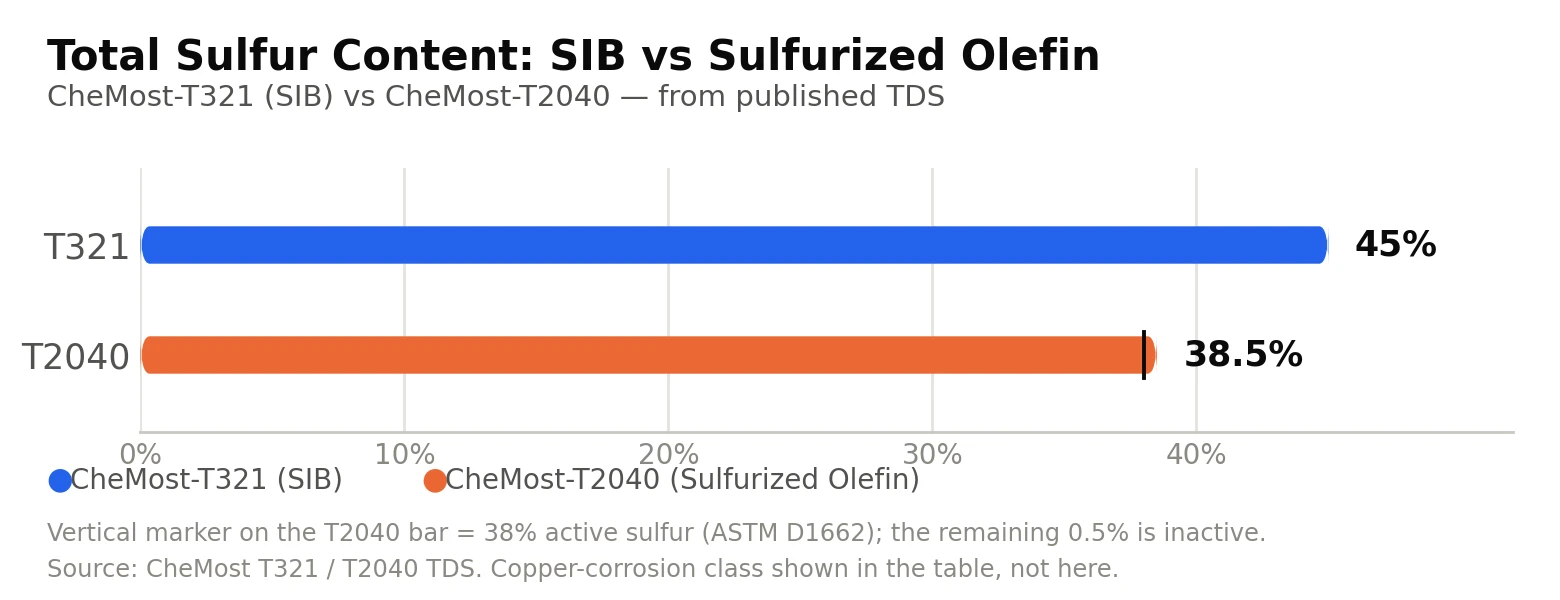
| Total sulfur | 45% | 38.5% total (38% active) |
| Appearance | Light yellow liquid | Light yellow, low-odour liquid |
| Copper corrosion (ASTM D130) | 2e | 3b |
| EP test value | PD weld load 650 @ 3% (ASTM D2596) | Weld point 320 kg, four-ball (ASTM D2783) |
| Chlorine | Chlorine-free | Not stated chlorine-free on TDS |
| Primary duty | Automotive & industrial gear oils | Water- & oil-based metalworking fluids; gear oils secondary |
Read the EP numbers with one caveat: T321 and T2040 are tested to different ASTM methods (D2596 vs. D2783). The 650 and 320 kg figures aren’t on the same scale, so don’t subtract one from the other — treat each as that grade’s own EP ceiling within its own test method, not a head-to-head score.
What the Numbers Actually Mean for Your Formulation
The counterintuitive part: T321 carries more total sulfur (45% vs. 38.5%) but rates less corrosive to copper (D130 2e vs. 3b) — backwards from what “total sulfur %” alone would suggest.
The reason is activity, not quantity. T2040’s TDS reports 38% active sulfur out of 38.5% total — almost all of its sulfur is reactive. T321’s high-pressure synthesis route is described on its own data sheet as giving a lighter color and more controlled activity for the same high-EP job. More of T2040’s sulfur is doing corrosive work at room temperature, even though its total number is smaller.
For your formulation, that means: when yellow-metal components (copper, brass, bronze) are in the system, don’t screen candidate sulfur carriers by total sulfur % on the spec sheet — ask for the ASTM D130 class and the active-sulfur split. A lower-total-sulfur grade can still be the more corrosive choice. Where copper contact is unavoidable, both T321 and T2040 are typically paired with a copper metal deactivator such as benzotriazole, or dosed down to trade EP strength for a lighter corrosion class.
Which Grade Fits Your Application?
T321 (SIB) is the higher-sulfur, single-carrier EP workhorse for automotive and industrial gear oils, where a strong iron-sulfide film under shock load is the priority. T2040 (sulfurized olefin) is built for water- and oil-based metalworking fluids — cutting, forming, drawing — where its lighter color and lower odor suit modern fluid formulations, with gear-oil use as a secondary fit.
The two aren’t mutually exclusive: both TDS sheets note they’re commonly combined with each other and with a phosphorus EP/antiwear additive to tune total activity, viscosity and EP level rather than relying on either sulfur carrier alone. Full sulfur-carrier selection and treat-rate guidance is available from the EP additives team on request.
Frequently Asked Questions
Is sulfurized isobutylene (SIB) technically a sulfurized olefin?
Yes. Isobutylene is an olefin, so SIB is the isobutylene-derived branch of the sulfurized-olefin family. Commercially, “sulfurized olefin” products (like CheMost T2040) are usually built on a different olefin backbone, tuned for metalworking fluids rather than gear-oil EP duty.
Does higher sulfur content always mean worse copper corrosion?
No. CheMost-T321 has more total sulfur (45%) than T2040 (38.5%) but rates less corrosive on ASTM D130 (2e vs. 3b), because T2040’s sulfur is almost entirely active. Screen by D130 class and active-sulfur ratio, not total sulfur % alone.
How is active sulfur measured?
ASTM D1662 measures the sulfur that reacts with copper powder at 149°C over one hour — that reacted portion is the “active” sulfur. Inactive sulfur is chemically stable at that temperature and contributes to EP performance without the same room-temperature copper risk.
What’s the standard way to offset active-sulfur copper corrosion?
Pair the sulfur carrier with a copper metal deactivator such as benzotriazole, or moderate the treat rate / choose a lower-activity grade. Both are standard practice on the T321 and T2040 data sheets, not a workaround unique to one grade.
About This Guide
Data in this comparison is drawn directly from CheMost’s own T321 (SIB) and T2040 (sulfurized olefin) technical data sheets, cross-checked against ASTM D130/D1662 method descriptions and third-party sulfur-carrier literature (see References). Neither product carries an OEM or industry certification claim — certifications belong to the fully formulated finished lubricant, not the additive component. Need the full TDS or help choosing between T321, T2040, or a blend for your yellow-metal-sensitive system? Request samples or the full technical data sheet.
References & Industry Standards
- ASTM D130 — Standard Test Method for Corrosiveness to Copper from Petroleum Products (Copper Strip Test)
- ASTM D1662 — Standard Test Method for Active Sulfur in Cutting Oils
- ASTM D2596 / ASTM D2783 — Standard Test Methods for Measurement of Extreme-Pressure Properties of Lubricating Fluids (Four-Ball Method)
- Sea-Land Chemical Company, “Sulfurized EP Additives” — sulfurized-olefin carrier structure and ASTM D-130 data reference
- Lubrizol, “Olefin Sulfides in Lubricant Additives” — carrier chemistry and regulatory background
Related Articles
EP vs Anti-Wear Additives: How to Tell Them Apart on a Data Sheet