Lubricant Additive Components
CheMost supplies demulsifier and emulsifier additives for lubricants and metalworking fluids — the interfacial chemistry that does two opposite jobs: making oil and water separate cleanly, or holding them together as a stable emulsion.
These are additive components for lubricant and metalworking-fluid formulators — not oilfield crude-oil demulsifier programs for wellhead separation, and not the consumer “water in diesel” bottles. The range covers both directions: emulsifiers that build stable emulsions for soluble and semisynthetic cutting fluids, and demulsifiers that promote fast water separation in turbine, hydraulic and circulating oils. Decide which job you need below, then open a product page for documentation.
Browse CheMost Emulsifiers & Demulsifiers
Start with the product family that best matches your formulation target. Each product page goes deeper into the exact grade, properties, and documentation.
Two Opposite Jobs in One Additive Family
Emulsifiers and demulsifiers are both interfacial (surface-active) tools, but they pull in opposite directions — so the very first thing to settle is which one your fluid needs:
- Demulsifier → break the emulsion. It promotes oil/water separation so water that gets in (condensation, steam, coolant leaks) drops out fast and can be drained. STLE defines a demulsifier simply as “an additive that promotes oil/water separation in lubricants that are exposed to water or steam.” This is what turbine, hydraulic, gear and circulating oils need.
- Emulsifier → stabilise the emulsion. It does the reverse — it keeps oil and water mixed as a fine, stable emulsion that does not separate on standing. This is what soluble (emulsifiable) and semisynthetic metalworking fluids need, where the working fluid is deliberately an oil-in-water emulsion.
They are not a “better/worse” pair — they are opposite goals. An additive that is excellent at one is, by definition, wrong for the other, so selection starts with the application, not the product.
Why Water Separation (Demulsibility) Matters
Water finds its way into almost every industrial oil. It shows up three ways — dissolved, emulsified and free — and the last two are the damaging ones. Emulsified and free water lower the effective viscosity and load-carrying film, form sludge and deposits, and accelerate oxidation, wear and rust and corrosion. The catch is that many polar additives (detergents, some rust inhibitors and EP agents) raise the oil’s tendency to hold water, which works against demulsibility. Good water-shedding is therefore a property that has to be designed into the oil — partly through additive choice and partly with a demulsifier.
Demulsibility is read with standard methods: ASTM D1401 (water separability of petroleum oils and synthetic fluids — it reports the oil/water/emulsion volumes and the time to separate, e.g. 40-37-3 in 15 minutes) and ASTM D2711 (demulsibility characteristics for higher-additive and EP-type oils). A finished oil is validated against these, not assumed.
Choosing an Emulsifier — The HLB Idea
On the emulsifier side, selection is governed by HLB (hydrophilic-lipophilic balance) — a number for how water-loving versus oil-loving a surfactant is. As a rule of thumb, an HLB of roughly 3–6 favours a water-in-oil emulsion, while 8–18 favours oil-in-water. Most practical emulsifier systems blend a low-HLB and a high-HLB surfactant to hit the target for the base oil being emulsified. In metalworking, sodium petroleum sulfonates are the classic primary emulsifier for soluble cutting oils. Emulsion stability is never down to the emulsifier alone — it also depends on the base oil and the water hardness it will be mixed with.
The CheMost Range — How to Choose
CheMost covers both directions. Start with the job — build a stable emulsion, or break one:
Emulsifiers — build & stabilise emulsions (soluble oils & MWF)
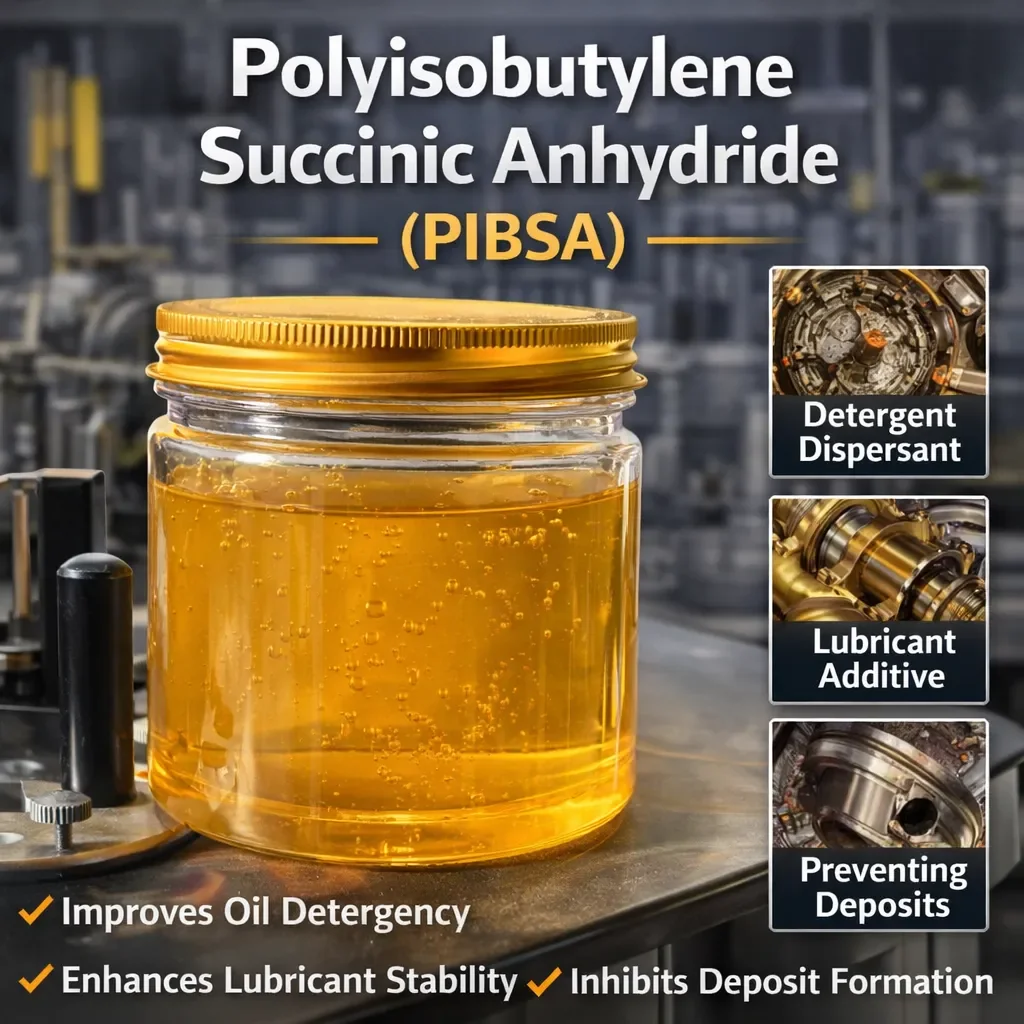
Polyisobutylene Succinic Anhydride (PIBSA)
Type: Oil-soluble PIB-anhydride intermediate.
Best for: The oil-soluble hydrophobe used to build water-in-oil emulsifiers and their derivatives — and the backbone for ashless succinimide dispersants. A versatile intermediate rather than a finished emulsifier.
Demulsifiers — break emulsions & shed water (turbine, hydraulic, circulating oils)
Amine Polyether Demulsifier (AP Type)
Type: Amine-initiated oxyalkylated polyether demulsifier.
Best for: Breaking water-in-oil emulsions and speeding water release where an oil has to shed contaminating water quickly.
Polyether Demulsifier (SP Type)
Type: Polyether demulsifier.
Best for: Water separation in turbine and hydraulic oils — helping the finished oil meet its demulsibility target so water drains rather than emulsifying.
Treat Rate & Formulation Reality
The two directions sit at opposite ends of the dosing scale:
- Demulsifiers are low-treat, high-impact. They are used at small additions and must stay soluble or stably dispersible in the oil over its life. Published fuel-additive data shows demulsifiers used at only ~1–200 ppm — useful as an order-of-magnitude, but it is fuel data and should not be read as a universal lubricant treat rate.
- Emulsifiers are a major component. In a soluble-oil or semisynthetic concentrate the emulsifier package is one of the largest ingredients, not a trace additive, because it has to carry the whole oil phase into a stable emulsion when diluted with water of variable hardness.
Exact dose and combinations depend on your base oil, the rest of the package, your water quality and the demulsibility or emulsion-stability target. CheMost can advise on grade and starting point on request.
Common Applications
- Turbine & circulating oils: fast water shedding (ASTM D1401) so condensate and steam leakage drain off and do not emulsify or form sludge — a demulsifier job.
- Hydraulic fluids: water separation to protect the film and prevent rust and valve problems — a demulsifier job.
- Industrial gear & compressor oils: demulsibility under water and steam exposure.
- Soluble (emulsifiable) cutting oils: a stable, fine oil-in-water emulsion at the point of use — an emulsifier job.
- Semisynthetic metalworking fluids: emulsion stability across the working dilution and varying water hardness — an emulsifier job, paired with foam control.
Need help choosing — emulsify or demulsify?
Tell us your fluid, your base oil, your water quality and whether you need water to separate (turbine, hydraulic, circulating oils) or to stay emulsified (soluble and semisynthetic metalworking fluids). We will point you to the right chemistry and treat rate, then share the relevant technical documents.
Request a Sample Get a QuoteEmulsifiers and demulsifiers are specified across Industrial Lubricant, Metalworking and Automotive Lubricant formulations, alongside rust inhibitors, antioxidants and foam inhibitors. For deeper background see our notes on emulsifier chemistry in semi-synthetic cutting fluids, PIBSA-based emulsifiers and turbine-oil water and rust behaviour.
Quick Reference
What is a demulsifier?
A demulsifier is an additive that promotes oil/water separation in lubricants exposed to water or steam. When water gets into a turbine, hydraulic or circulating oil, a demulsifier helps it coalesce and drop out so it can be drained, rather than staying as a damaging emulsion. It is used at low treat rates and must remain soluble or stably dispersible in the oil.
What is the difference between an emulsifier and a demulsifier?
They do opposite jobs. An emulsifier keeps oil and water mixed as a stable emulsion (what a soluble or semisynthetic metalworking fluid needs); a demulsifier does the reverse and makes oil and water separate (what a turbine or hydraulic oil needs). The right choice depends entirely on whether your fluid is supposed to be an emulsion or supposed to shed water.
Which oils need a demulsifier, and which need an emulsifier?
Turbine, hydraulic, circulating, industrial gear and compressor oils need good water separation — a demulsifier. Soluble (emulsifiable) cutting oils and semisynthetic metalworking fluids are deliberately oil-in-water emulsions — an emulsifier. CheMost supplies both directions so you can match the additive to the fluid.
How is demulsibility (water separation) measured?
With standard test methods — ASTM D1401 (water separability of petroleum oils and synthetic fluids), which reports the oil, water and emulsion volumes and the time to separate, and ASTM D2711 (demulsibility characteristics) for higher-additive and EP-type oils. A finished oil is validated against these rather than assumed; our team can advise on hitting the target.
How do I choose an emulsifier — what is HLB?
HLB (hydrophilic-lipophilic balance) is a number for how water-loving versus oil-loving a surfactant is. Roughly, HLB 3–6 favours water-in-oil emulsions and 8–18 favours oil-in-water, and most systems blend a low-HLB and a high-HLB emulsifier to reach the target for the base oil. Sorbitan monooleate (Span 80) sits at about 4.3 — a low-HLB choice. Stability also depends on base oil and water hardness.
Is this an oilfield crude-oil demulsifier or a diesel water-treatment additive?
No. CheMost supplies emulsifier and demulsifier additive components to lubricant and metalworking-fluid formulators — in drums and IBCs. These are raw materials for oil blenders, not the oilfield crude-oil demulsifier programs used for wellhead separation, and not the consumer aftermarket “water in diesel” bottles.
Explore Other Additive Components
Every CheMost additive component, at a glance. Build a complete formulation — open any family to see its full product range, grades, and treat rates.