Anti-wear (AW) additives protect metal surfaces under moderate loads by forming sacrificial, phosphate-rich boundary films — zinc dialkyldithiophosphate (ZDDP) is the classic chemistry. Extreme pressure (EP) additives activate under high loads and temperatures, reacting with the metal to build sulfur-based films that prevent scuffing and welding. Same boundary regime, different activation thresholds.
Two failures look deceptively similar on a purchase order. The first is a hydraulic pump whose vanes are slowly losing metal — steady adhesive wear. The second is a gearbox that came back with scuffed tooth flanks after one shock overload. Both get called “wear.” They are not the same problem, and they are not solved by the same additive.
Buying the wrong side of the EP vs anti-wear additives line is expensive in both directions. An aggressive sulfur EP package in a hydraulic pump corrodes yellow-metal components. A mild anti-wear package in a hypoid axle leaves the gear set unprotected when torque spikes. The difference is written in activation chemistry, and it is measurable on a data sheet if you know which numbers to read.
Who this guide is for: formulators and additive buyers at lubricant, grease and metalworking-fluid blenders who need to choose between AW and EP chemistries — and defend that choice with test data. We explain the test-method numbers and TDS fields that decide the purchase.
The Real Line Between AW and EP: Activation Conditions
Anti-wear additives work under moderate stress, in mixed and boundary lubrication, where asperities intermittently touch through a thinning oil film. EP additives step in when load or shock collapses that film entirely and the failure mode shifts from gradual metal loss to scuffing, galling and welding. On the Stribeck map both live below a lambda ratio of 1, where the fluid film no longer separates the surfaces. What separates them is when they wake up.
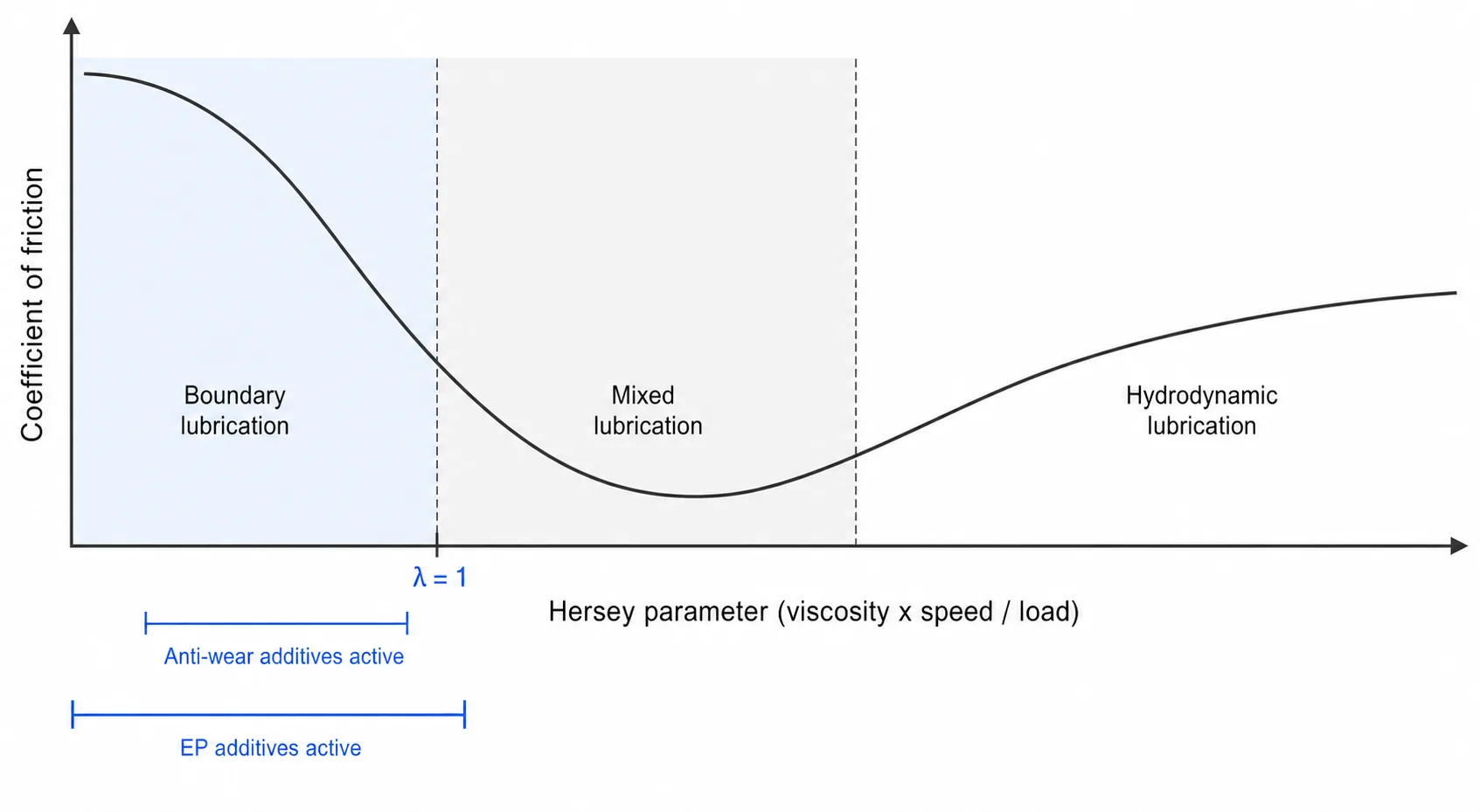
Here is the uncomfortable truth most supplier pages skip: the boundary between the two categories is not a wall, it is a spectrum. A standard textbook on ashless chemistries states it plainly — “the distinction between antiwear and EP additives is not clear-cut,” and EP additives “come in mild and strong flavors.” Some authors have even suggested renaming EP additives “antiscuffing additives,” because the real difference is the severity regime, not the element on the label.
The cleanest way to read the line is activation conditions. Research literature describes an activation ladder: fatty soaps react at the lowest temperatures, then chlorine chemistries, then phosphorus, with sulfur reacting at the highest temperatures. ZDDP, the AW benchmark, forms its protective film under rubbing even at low temperature, with thermally formed films also reported above 150 °C. One-line definitions live in our glossary entries for EP additive and anti-wear additive — the rest of this guide is about what the difference costs you in practice.
The Chemistry Split: Phosphorus Wears the AW Badge, Sulfur Takes the EP Shift
As a rule of thumb, phosphorus chemistry anchors the anti-wear side and sulfur chemistry anchors the EP side — with ZDDP straddling both. A widely cited category scorecard (1 = best) rates phosphorus 1 for anti-wear and 3 for EP, sulfur 3 and 1, and ZDDP 1/3/3 across anti-wear, EP and friction modification. That single table explains most real formulations.
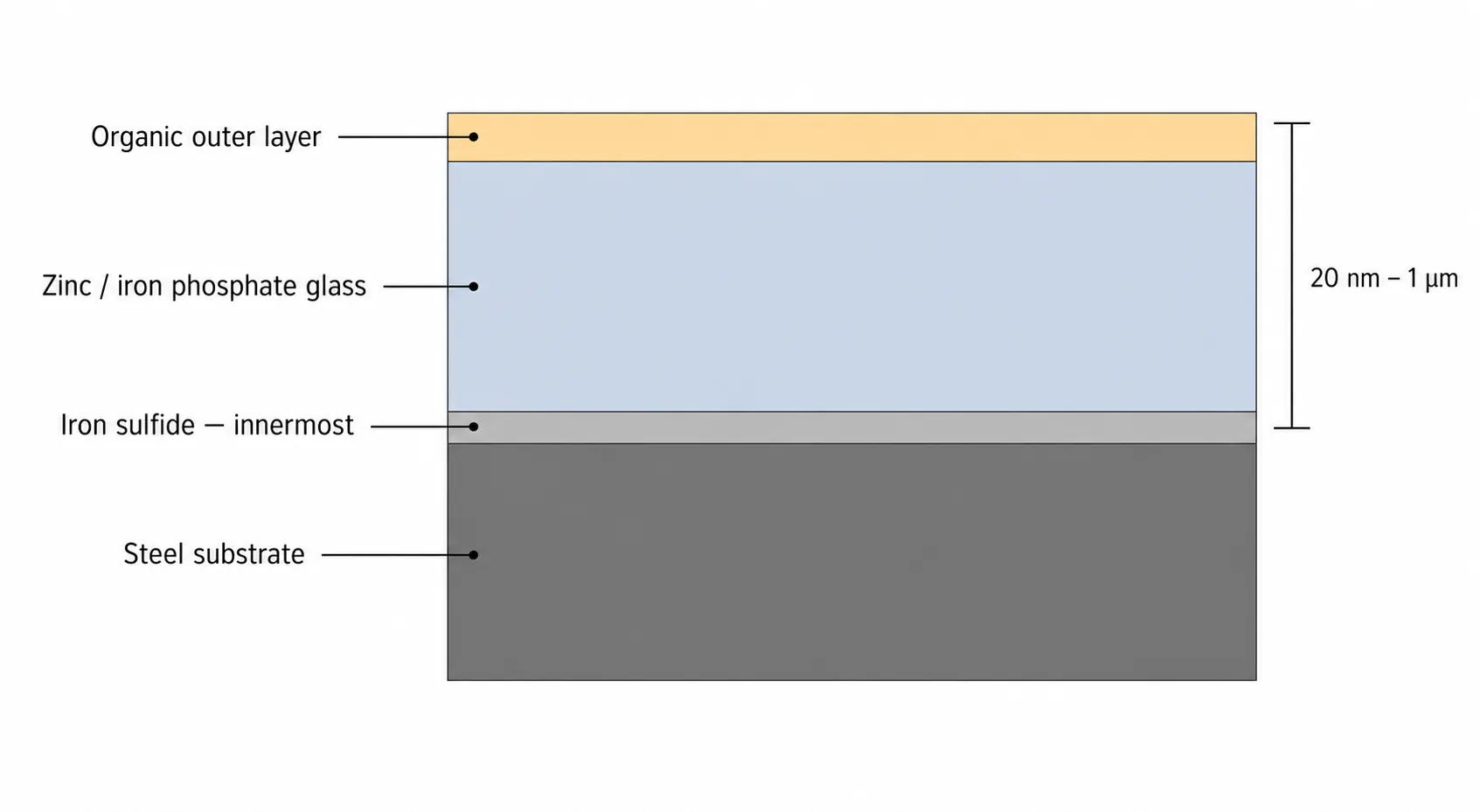
On the AW side, ZDDP remains the benchmark because it is genuinely multifunctional — “an excellent antiwear agent, a mild extreme-pressure (EP) agent, and an effective oxidation and corrosion inhibitor,” at low cost. Its film is layered — iron sulfide at the interface, a zinc-and-iron phosphate glass above, an organic outer layer — measured from 20 nm to 1 μm. Commercial grades differ by alkyl structure: our primary-secondary ZDDP (SPZS-M1, 7.45% P, 14.82% S) is built for hydraulic and industrial oils, where hydrolytic stability matters as much as film speed.
Ashless phosphorus chemistry covers buyers who need AW performance without zinc: phosphate esters, amine phosphates, and phosphorothioates. Triphenyl phosphorothioate (TPPT) is the compact example — 9.0% phosphorus and 9.3% sulfur in one molecule, an anti-wear film with mild EP support at roughly 0.1–1% treat.
On the EP side, sulfur is the workhorse. Sulfurized isobutylene (SIB) at 45% total sulfur has been the standard gear-oil EP chemistry for decades — used in virtually every automotive gear package and most industrial ones. Sulfurized olefin offers a lighter-colour, lower-odour carrier oriented to metalworking.
Where yellow metals are present, the choice flips to low-activity carriers like sulfurized triglyceride (T3011): 11% total sulfur but only 1% active, rated 1a on the ASTM D130 copper strip.
What this means for your formulation: read the chemistry family off the TDS before any performance claim. “EP additive” is a marketing slot; phosphorus vs sulfur content and active-sulfur level tell you what the molecule will do at 3 a.m. in a shock-loaded gearbox.
How Do You Actually Measure EP vs Anti-Wear?
Anti-wear performance is measured as wear scar or friction under sustained moderate load; EP performance is measured as the load at which the film fails and metal welds. A supplier who quotes one to prove the other is telling you nothing — and this is the part procurement actually needs.
| Test | Method | What it measures | Side |
|---|---|---|---|
| Four-ball wear | ASTM D4172 (oils) / D2266 (greases) | Wear scar diameter under moderate load | AW |
| SRV / Falex | ASTM D5707 / D6425 / D2714 | Oscillating or sliding friction and wear | AW |
| Four-ball EP (weld load) | ASTM D2596 | Load at which balls weld | EP |
| Four-ball LWI | ASTM D2783 | Load-Wear Index from scar-vs-load curve | EP |
| Timken OK load | ASTM D2782 (oils) / D2509 (greases) | Load capacity before scoring | EP |
| FZG scuffing | ASTM D5182 | Gear scuffing load stage | EP |
| Copper strip | ASTM D130 / D4048 / D1662 | Corrosivity of active sulfur to copper alloys | Activity check |
What this means for your purchasing: ask for D2596 or D2783 weld data when you buy EP protection, D4172 scar data when you buy anti-wear, and D130 whenever active sulfur is in the room. “Excellent EP performance” without a method number is a slogan, not a specification.
Reading the Numbers: What Real TDS Data Tells You
Specifications get concrete fast when you put real data sheets side by side — two AW anchors, one ashless phosphorus, three sulfur carriers across the activity spectrum, all published specs from our own range:
| Product | Chemistry | Key TDS figures | Copper strip (D130) | Load-carrying data | Typical treat |
|---|---|---|---|---|---|
| ZDDP, primary (SPZS-S1) | AW, Zn-P-S | S 15.5% · P 7.2% · Zn 8.55% | — | — | Engine 1.0–3.0% · industrial 0.2–5.0% · grease 0.5–3.5% |
| ZDDP, primary-secondary (SPZS-M1) | AW, Zn-P-S | S 14.82% · P 7.45% · Zn 9.22% | — | — | Engine 1.0–3.0% · industrial 0.2–5.0% |
| TPPT | Ashless P-S, AW + mild EP | P 9.0% · S 9.3% | — | — | ~0.1–1% (indicative) |
| SIB (T321) | EP, sulfur carrier | S 45% | 2e (121 °C, 3 h) | Weld load 650 kg at 3% (D2596) | 1–5% (indicative) |
| Sulfurized olefin (T2040) | EP, sulfur carrier | S 38.5% total · 38% active | 3b (100 °C, 3 h) | Weld point 320 kg (D2783) | 1–5% (indicative) |
| Sulfurized triglyceride (T3011) | EP/lubricity, low activity | S 11% total · 1% active | 1a | — | 1–5% (indicative) |
Three reading rules. First, weld numbers from different methods are not directly comparable — 650 kg on D2596 and 320 kg on D2783 are different test geometries, not a contradiction. Second, active sulfur — not total sulfur — drives both film speed and copper aggression: higher activity films faster but wears and corrodes more, and D130 can be masked by passivators, so never use it alone to judge activity. Third, element content converts directly into formulation budgets: 1.0 wt% of a 7.2% P ZDDP contributes about 0.072% phosphorus (720 ppm) to the finished oil — headroom math against the 0.06–0.08 mass % phosphorus windows in current ILSAC GF-6/GF-7 categories.
What this means for your next TDS review: check chemistry (S/P/Zn), activity (active sulfur, D130), and test evidence (method number + value) before you compare prices — and ask any supplier who cannot produce the same table why not.
From the labSpeccing a hydraulic, gear or turbine oil? CheMost supplies the chemistry.Browse industrial packagesWhich One Does Your Application Need?
The main arenas, matched by failure mode:
- Hydraulic systems → anti-wear. ZDDP at 0.2–0.7 wt% inside total packages of 0.5–1.25%, primary ZDDP preferred for hydrolytic stability. One warning worth memorizing: ZDDP can cause catastrophic failure at the steel–copper-alloy interfaces of axial piston pumps. (Anti-wear selection for hydraulic oil applications deserves its own guide — watch this space.) See our antiwear additives and ZDDP range for the options.
- Automotive gear oils → EP backbone. GL-4/GL-5 protection is built on sulfur carriers, ZDDP at 1.5–4% assisting, in total packages of 5–12%. Industrial enclosed gears increasingly run ashless sulfur-phosphorus systems at 1.5–3% under AGMA 9005 / ISO 12925 frames. Worm gears with bronze wheels are the exception: high-activity sulfur is off the table — use low-activity carriers like T3011 from the EP additive range.
- Greases → EP plus solids. A grease carries 0.5–10% additives on top of base oil and thickener, and chemisorbed EP films protect to roughly 400 °C. At a standard 3 wt% treat in four-ball EP testing, a base grease’s 126–180 kg weld load rises to 250–315 kg with ZDDP and 400–500 kg with MoS2. Passivators cannot be relied on inside a grease, so low-activity sulfur is the safe default with copper alloys.
- Engine oils → AW under a phosphorus budget. ZDDP remains the core anti-wear/antioxidant chemistry, compressed into the 0.06–0.08% phosphorus windows of modern ILSAC categories — a full discussion belongs to our ZDDP guide (linked in the FAQ below).
- Metalworking fluids → active sulfur under a copper limit. Cutting and forming fluids use high-activity carriers tuned between the weld-load target and the D130 limit — territory for a dedicated guide elsewhere on this blog.
What this means for your sourcing list: write the hardware’s failure mode on the spec first — scuffing, pitting, vane wear, bronze compatibility — then buy the chemistry that addresses it.
Can AW and EP Additives Replace Each Other?
No — and they were never meant to. Swapping one for the other fails in both directions: anti-wear films break down under EP-level loads, and dormant EP chemistry at mild conditions adds cost, corrosivity and seal risk with zero benefit. But inside a real additive package, AW and EP additives are not rivals — they are complements. Major suppliers describe EP fluids as “usually supplemented with anti-wear additives” to cover a wide pressure-temperature range. The interaction is measurable: ZDDP suppresses the copper corrosion of sulfur carriers (D130 ratings improving from 4c to 3b and 3a to 1b in documented blends), and a sulfurized olefin at 1.5% combined with a TMP ester at 3.5% outperforms either alone — a 3,200 N weld load with a 0.55 mm wear scar in DIN 51350 testing. In Europe, ZDDP/sulfurized-olefin pairing has replaced antimony and lead in high-EP greases and chlorinated paraffins in medium-duty metalworking fluids.
Our position: for a steel-on-steel hypoid gear set, build on a sulfur EP carrier and stop asking ZDDP to do its job; for a mixed-metal hydraulic system, build on a ZDDP or ashless phosphorus AW core and keep active sulfur out. For anything in between — and most industrial formulations are in between — the answer is a balanced pair, not a winner. If you are weighing two sulfur carriers against each other, our SIB vs sulfurized olefin comparison reads the numbers side by side.
Need the EP/AW balance tuned to your formulation? Our technical team works through treat rates, activity levels and yellow-metal constraints with you → Talk to us.
Frequently Asked Questions
Are EP and anti-wear additives the same thing?
No. They overlap in the boundary regime but activate under different severity: anti-wear chemistry forms sacrificial films under moderate load; EP chemistry reacts under high load and temperature to prevent welding. The purchase decision splits cleanly on activation conditions.
Can I use an EP additive instead of an anti-wear additive in hydraulic oil?
Not safely. Active-sulfur EP chemistry corrodes yellow-metal pump components, attacks seals and stays dormant at hydraulic operating temperatures — cost without protection. Hydraulic anti-wear is a ZDDP or ashless phosphorus brief, typically 0.2–0.7 wt%.
Is ZDDP the same as zinc?
No. ZDDP (zinc dialkyldithiophosphate) is an organometallic compound of zinc, phosphorus and sulfur — in commercial grades zinc accounts for roughly 8.5–9.2% of the additive by weight, and the phosphorus and sulfur do much of the surface work. For the full mechanism, see our guide on what ZDDP is.
What test numbers should I ask for when buying an EP additive?
Ask for four-ball weld load (ASTM D2596) or Load-Wear Index (D2783), an FZG scuffing stage (D5182) where gears are involved, and a copper-strip rating (D130) for yellow-metal risk. For anti-wear, ask for the four-ball wear scar (D4172). Our sulfurized isobutylene (SIB) data sheet, for example, reports a 650 kg weld load at 3% treat by D2596 — that is the specificity to expect.
Do greases use the same EP additives as gear oils?
Mostly the same families — sulfur carriers, ZDDP, ashless phosphorus — plus solids like MoS2 and graphite that liquid oils rarely use. One constraint tightens in grease: passivators cannot mask active sulfur there, so copper-alloy applications need genuinely low-activity carriers.
What does an EP or anti-wear additive cost?
We do not quote prices in guides — the honest answer depends on chemistry family, activity level, treat rate and volume, and the cheapest per-kilo option can be the most expensive per treated litre. What we will do is price against your formulation target; that starts at our contact page.
About This Guide
This comparison was written by the CheMost technical content team, drawing on published tribology literature, ASTM method documentation and our own production data sheets. Its purpose is to make the EP/AW distinction purchasable: chemistry first, test numbers second, brand last. Every CheMost figure quoted comes from its published TDS; approvals such as API GL-5 or AGMA ratings belong to fully formulated oils, not to individual additive components. If your formulation sits on the AW/EP boundary — most do — our engineers can help you balance it: contact us.
References & Industry Standards
- Farng, L. O., “Ashless Antiwear and Extreme-Pressure Additives,” in Lubricant Additives: Chemistry and Applications.
- Phillips, W. D., “Ashless Phosphorus-Containing Lubricating Oil Additives,” in Lubricant Additives: Chemistry and Applications.
- McDonald, R. A., “Zinc Dithiophosphates,” in Lubricant Additives: Chemistry and Applications.
- ASTM D2596, D2783, D4172, D130, D4951, D5182 — standard test methods, ASTM International.
- API Publication 1509, Engine Oil Licensing and Certification System, 23rd Edition, American Petroleum Institute.
- Zhang, J., & Spikes, H. (2016), “On the Mechanism of ZDDP Antiwear Film Formation,” Tribology Letters.
- Gosvami, N. N., et al. (2015), “Mechanisms of antiwear tribofilm growth revealed in situ by single-asperity sliding contacts,” Science.
- “Understanding the Differences Between Lubricant Additives,” Machinery Lubrication (Noria Corporation).
Related Articles
Calcium Sulfonate Grease vs Lithium Complex: Reading the ISO Code
Demulsifier Guide: How Demulsifiers Work and How to Choose One