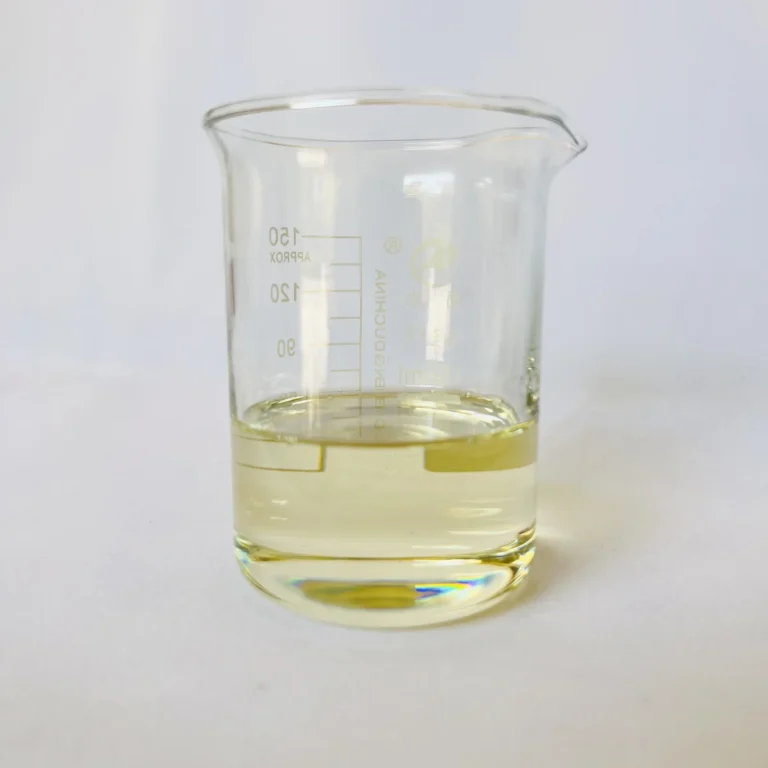
A demulsifier additive is a surface-active additive that forces emulsified water to separate out of oil. The name says what it does — it de-emulsifies: it breaks the stable dispersion of water droplets in oil by displacing the emulsifying film at the oil–water interface, so droplets coalesce, grow heavy, and settle out by gravity.
If you formulate or blend industrial oils, three facts frame every demulsifier decision. First, demulsibility is verified by standardized bench tests — ASTM D1401 for turbine-viscosity oils, ASTM D2711 for heavier oils — not by supplier adjectives. Second, the expensive mistakes are compatibility failures: the demulsifier fights the polar components already in your formula, and an overdose can cloud the oil. Third, the working dose is small — on the order of 100 ppm — yet pass or fail can come down to a few ppm of the wrong contaminant.
Who this guide is for, and who should skip ahead: plant lubrication engineers and oil blenders writing or auditing a demulsibility spec. If you came for crude-oil dehydration chemicals, jump to the crude section — related chemistry, different discipline, and we do not position a crude product line.
What does a demulsifier actually do?
Water in a lubricant exists in three states: dissolved, emulsified, and free. Dissolved water is mostly harmless up to the saturation point. Free water settles and can be drained. Emulsified water is the destructive state — it cuts effective viscosity and load-carrying capacity, forms sludge, and accelerates wear and corrosion.
A demulsifier’s job is to move water from the emulsified state to the free state fast enough for the system to get rid of it — in STLE’s phrasing, it “promotes oil/water separation in lubricants that are exposed to water or steam”. It is the exact opposite of an emulsifier, which stabilizes oil-water mixtures (soluble oils, metalworking fluids); a demulsifier destabilizes them so the phases split.
What this means for your oil: in a circulating system, demulsibility decides whether incoming water leaves in the reservoir or rides back into bearings, pumps, and control valves.
How do demulsifiers break an emulsion?
Why does the emulsion exist? Disperse 10 cm² of oil into 0.1 µm droplets and the oil–water interfacial area balloons to roughly 300 m² — about a million-fold increase in interfacial free energy. The system wants to separate, but emulsifying species freeze it in place: natural polar compounds, oxidation products, or deliberately added surfactants (detergents, some rust inhibitors) adsorb at the droplet surface and form a stabilizing film.
A demulsifier is engineered to be more interface-active than whatever is stabilizing the droplets. It migrates to the oil–water interface, displaces or weakens the emulsifying film, and lets droplets flocculate and coalesce into drops heavy enough to settle. In lubricating oils — where the emulsion is water-in-oil — the classical amine-polyether mechanism goes further: it breaks the emulsifier’s HLB balance and drives a phase inversion (W/O flipping to O/W) during which the phases split outright.
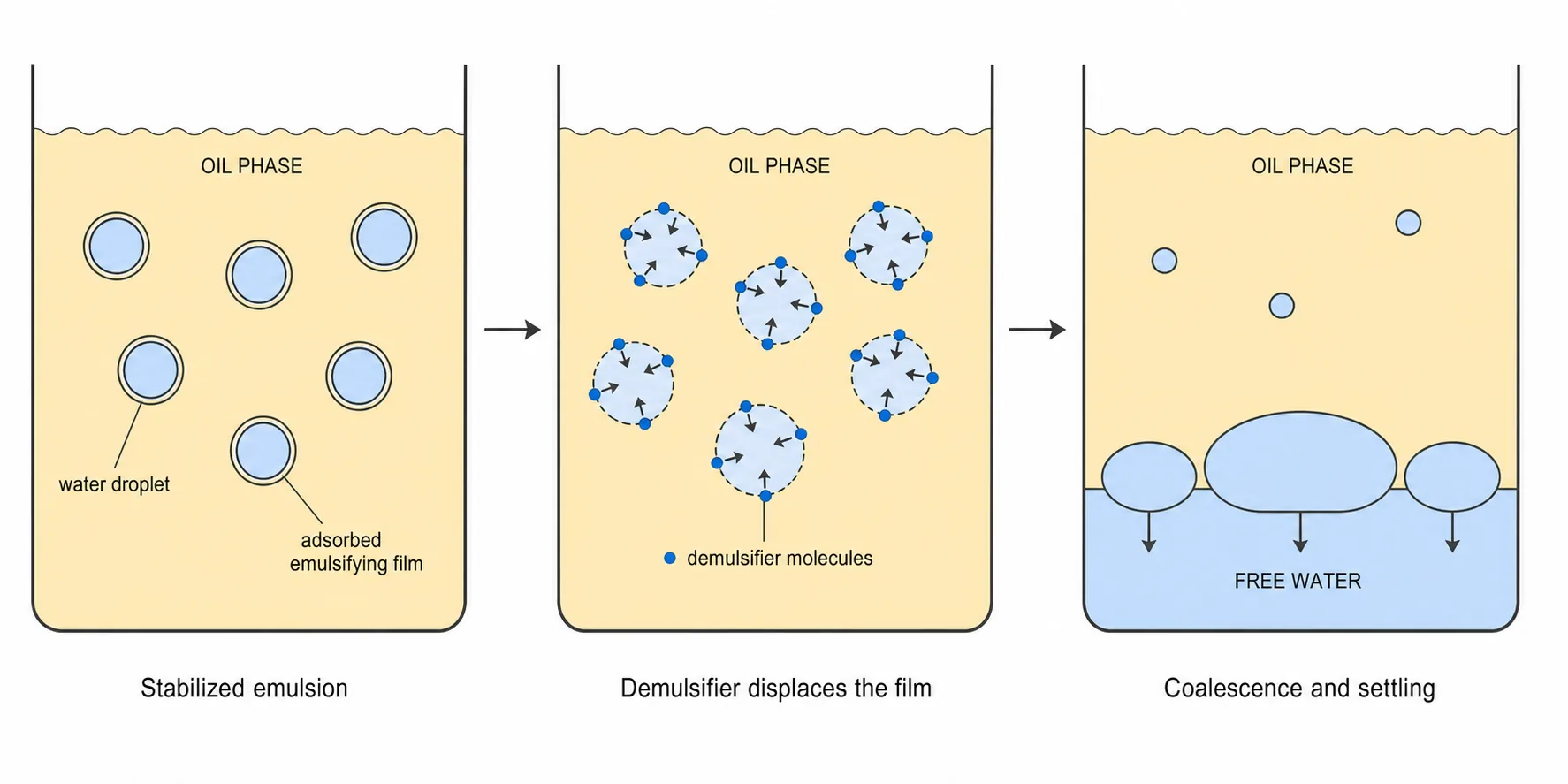
The structure behind that behavior: the textbook amine polyether (the T1001 class, the same family as our D1) carries two strongly hydrophilic tertiary amine nitrogens plus four weakly lipophilic polyoxypropylene chains; its HLB sits at 9.4–12.4, it dissolves only 0.15–0.3% in mineral oil, and its water solubility drops as temperature rises, so hot service does not wash it out of the oil. On the HLB scale: below ~9, oil-soluble, suits water-in-oil systems; above ~11, water-soluble, suits oil-in-water systems.
Chemistry types: which dissolves where, and why it decides the job
Surfactant taxonomy runs anionic / cationic / nonionic / zwitterionic / polymeric, but for buying decisions the working axis is simpler: where the molecule dissolves, and what that does to the emulsion in front of it.
| Type | Representative chemistry | Solubility behavior | Typical duty in lubricants |
|---|---|---|---|
| Amine polyether | Amine tetra-polyoxypropylene derivative (T1001 class) | Oil-side; solubility ceiling 0.15–0.3% in mineral oil | Turbine, hydraulic, industrial gear oils; synergizes with succinic-acid rust inhibitors |
| EO/PO block polyether | Nonionic polyoxyethylene/polyoxypropylene (T1002 class) | Oil-soluble, high flash point | Marine, turbine and hydraulic oils; contributes foam suppression |
| Polyalkoxylated phenols / polyols / polyamines | Alkoxylated resin types | Tuned by HLB | Turbine oils (D1401 / D2711) |
| Polyisobutylene-based | PIB derivatives | Oil-soluble | Industrial gear oils |
| Dual-function sulfonates | Neutral dinonylnaphthalene sulfonates (Ba/Ca/Zn/amine salts) | Oil-soluble | Rust prevention plus demulsification in hydraulic oils |
Sources: additive chemistry reference data (Lubricant Additives, Huang Wenxuan; industrial lubricant additive surveys).
A caution against a rule of thumb circulating online: “water-soluble demulsifiers break O/W emulsions, oil-soluble ones break W/O” is a starting heuristic at best. Real selection runs on HLB behavior plus a bench test in your base oil with your additive package — the same chemistry can demulsify at one dose and emulsify at another. CheMost keeps both lubricant-side chemistries in its emulsifier and demulsifier range for exactly this reason.
How is demulsibility tested — and how do you read the result?
Three methods cover the field; two belong in a lubricant specification.
| Method | Oils it covers | Test charge | What you report |
|---|---|---|---|
| ASTM D1401 | Turbine-viscosity oils (28.8–90 mm²/s at 40 °C), run at 54 °C; 82 ± 1 °C above 90 mm²/s | 40 mL oil + 40 mL water, stirred 5 min | Oil / water / emulsion mL vs time, e.g. 40-40-0 (20) |
| ASTM D2711 | Medium- and high-viscosity lubricating oils | 405 mL oil + 45 mL water at 82 °C (EP oils: 360 + 90) | Free water (mL), emulsion (mL), % water left in oil |
| Bottle test | Crude oil (field/lab screening) | Crude emulsion bottles on a dose ladder | Water dropout vs time and dose, plus interface and water quality |
D1401 results are read as three volumes and a time: 40-37-3 (20) means 40 mL oil, 37 mL water, 3 mL emulsion cuff, twenty minutes after stirring stopped. 40-40-0 is a perfect split; full separation in under 30 minutes says demulsibility is likely intact; 0-0-80 is the worst case — a stable emulsion that will not break (Machinery Lubrication). Labs typically end the test when the cuff drops below 3 mL, or at 30 minutes. ISO 6614 is the international counterpart; for marine service, D1401 allows 1% NaCl or synthetic seawater in place of distilled water.
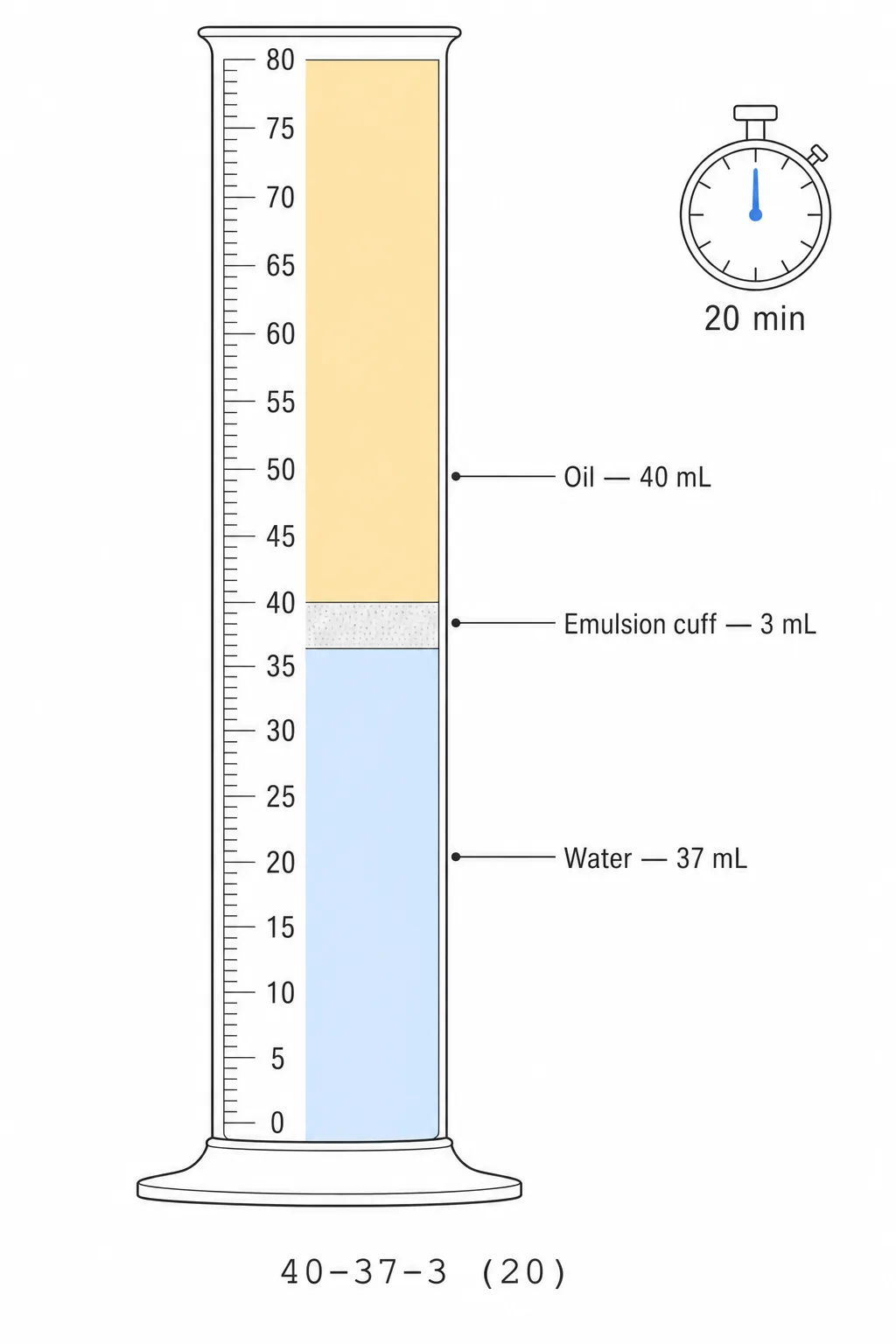
What this means for your spec sheet: write demulsibility as method + temperature + limit, not as “good demulsibility.” When monitoring oil in service, judge against the new-oil baseline — a drift from 40-40-0 (10) to 40-37-3 (30) means something is changing. For water limits: guidance for turbine oil applications flags 1,000 ppm (0.1%) as a condemning level, some OEMs under 500 ppm; hydraulic guidance puts ~600 ppm as the point where free water starts dropping out.
Which demulsifier fits your oil?
The selection logic is: oil type → water exposure → chemistry family → dose window → verify by D1401/D2711.
Turbine oils run on R&O (rust & oxidation) formulations with no AW/EP package, so demulsibility is a headline property. Steam and condensate ingress make fast water release essential; typical amine-polyether treat sits at 0.01–0.10%.
In hydraulic oil formulations, water enters through seal failures, cooler-coil leaks, and reservoir breathing in hot, humid climates. An antiwear hydraulic package runs about 0.6–1.5 wt% total performance additives, the demulsifier itself typically 0.03–0.15%. Zinc-containing (ZDDP) antiwear hydraulic oils are inherently demulsibility-challenged — a recurring formulation problem, not a bad batch.
Industrial gear oils must shed washdown and condensation fast; because most gear-oil additives are surface-active and shift the oil–water interfacial tension, demulsifier choice and package compatibility matter more than base oil alone. Typical treat: 0.02–0.05%. As a benchmark, a long-running commercial oil-film bearing oil line (ISO VG 150–680) publishes D2711 free water of 36–41 mL and D1401 (82 °C) times of 15–35 minutes to a 3 mL cuff.
In marine engine oils, water is a fact of life. For crosshead-engine system oils, water separability is performance requirement number one; trunk-piston engine oils carry detergents, dispersants and other polar additives that readily emulsify water — and the emulsion strips alkaline additives and can destroy bearings.
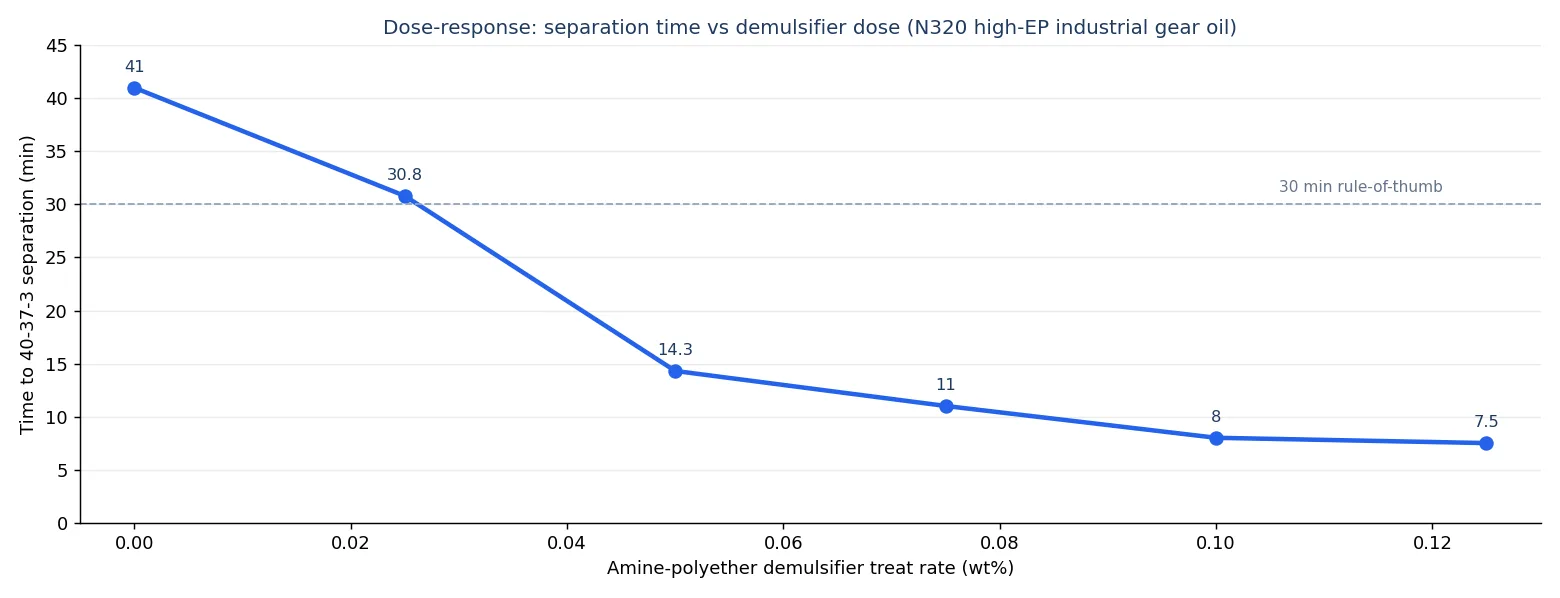
On dose, one dataset is worth a page of adjectives. In an N320 high-EP industrial gear oil, an amine-polyether (T1001-class) demulsifier cut the 40-37-3 separation time from 41.0 minutes untreated to 30.8 min at 0.025%, 14.3 at 0.05%, 11.0 at 0.075%, 8.0 at 0.10% — then a plateau: 7.5 min at 0.125%. The plateau is the point: past the dose the oil needs, you are paying for haze risk, not performance.
CheMost’s two lubricant-side demulsifiers:
| Property | D1 — amine polyether demulsifier | D2 — EO/PO polyether demulsifier |
|---|---|---|
| Chemistry | Amine groups + propylene oxide | Nonionic EO/PO polyether |
| Nitrogen | 0.6% (ASTM D5762) | — |
| Flash point (ASTM D93) | 130 °C | 235 °C |
| Demulsibility (TDS) | 5 min | 5 min |
| Guideline treat | ≈100 ppm (0.01 wt%) | ≈100 ppm (0.01 wt%) |
| Secondary benefit | Synergy with succinic-acid rust inhibitors; some antioxidancy | Helps suppress foam |
| Best suited to | Lube oils that contact water: hydraulic, turbine, industrial gear | Marine oils; hot, long-life turbine & hydraulic systems |
Source: CheMost D1 and D2 technical data sheets.
Our position: for steam-turbine and hydraulic R&O oils where the rust-inhibitor pairing matters, reach for the amine polyether D1; for marine oils and hot, long-service systems where foam control rides along, the EO/PO polyether D2 is the better starting point. Both are dosed to the D1401 result, not to a fixed percentage.
Need the full data package or a sample to run against your base oil? Both TDS sheets are available on request — or bring us your formulation and we will support the demulsibility optimization.
And crude oil demulsifiers?
Upstream is a different discipline. Crude oil carries water-in-oil emulsions stabilized by asphaltenes and resins, and selection runs on the bottle test: candidate chemistries dosed into bottles of the actual crude emulsion, ranked by water dropout against time and dose. The mechanistic framing — flocculation, then coalescence — is shared with the lubricant side, but the chemistries, dosages and qualification methods are not interchangeable. CheMost’s stocked demulsifier line serves lubricating oils; for oilfield-side requirements we can discuss custom formulation support rather than off-the-shelf supply.
Why demulsifiers fail in service — and what to check before adding more
When a formulated oil loses demulsibility, the demulsifier is rarely the root cause. Check these first:
- The polar package is holding the water. Rust inhibitors, detergents and dispersants are surface-active by design; they raise the oil’s water-holding capacity, and demulsibility is a whole-formulation property no single additive can guarantee. Zinc-based antiwear hydraulic oils are the recurring example.
- Contaminants at ppm level. Research cited by Turbomachinery International found as little as 3 ppm of calcium (detergent carryover) was enough to wreck a turbine oil’s demulsibility.
- Base-oil group paradox. Counterintuitively, more refining is not better: Group I oils tend to retain demulsibility better than Group II/III, with Group IV (PAO) most vulnerable — the purer the oil, the less it tolerates polar contamination.
- Oxidation. Aged oil generates surface-active oxidation products that stabilize emulsions. In a 121 °C / 321-hour oxidation test, gear oil with an amine-polyether demulsifier kept its separation at 6.0 minutes; the same oil without collapsed to 0-0-80-60 — no separation at all.
- Overdosing. Demulsifiers have a solubility ceiling — the amine polyether class dissolves only 0.15–0.3% in mineral oil — and dosing past it causes haze, not faster separation. Dose to the D1401 result.
- Blind field treatment. Dumping demulsifier into in-service oil can backfire — the additive is itself polar and can conflict with the aged package, sometimes worsening the emulsion. Test the treat on a sample first.
A legitimate synergy exists: pairing the amine-polyether demulsifier with a succinic-acid-type product from the rust and corrosion inhibitors family (0.015% + 0.015% in a turbine base oil) passed the distilled-water rust test clean, where the rust inhibitor alone failed heavily — the right pair keeps both rust protection and fast water release. The wrong pair does the opposite: acidic rust inhibitors reacting with water and divalent metals form sludge that plugs filters, which is why filterability-critical turbine oils have moved to non-reactive rust inhibitor chemistry.
And one system-level fork before you blame chemistry: if your reservoir can settle and drain free water, a demulsifying formulation is the right tool; if it cannot drain, an emulsifying approach that holds water in suspension may be the better answer.
What to ask a supplier (instead of “how do I make a demulsifier”): D1401/D2711 data run on your base oil viscosity, a dose-response curve, the solubility limit in your base stock, and a compatibility statement against your rust inhibitor and detergent package. A supplier who cannot produce those four is selling a commodity.
Demulsifier FAQ
What is the difference between an emulsifier and a demulsifier?
Same surfactant family, opposite jobs. An emulsifier stabilizes a mixture of oil and water — the basis of soluble oils and metalworking fluids. A demulsifier destabilizes it, forcing water to coalesce and drop out so it can be drained from turbines, hydraulics and other circulating systems.
Is an emulsion breaker the same as a demulsifier?
Yes — same function, different wording. “Emulsion breaker” is the common term in oilfield and crude contexts; lubricant specs and data sheets say “demulsifier,” and the measured property is “demulsibility” or “water separability.”
Can you give me some examples of demulsifiers?
For lubricating oils, the two classical nonionic families are amine polyethers and EO/PO block polyethers — the chemistry classes behind CheMost’s D1 and D2 grades. Turbine-oil formulations also use polyalkoxylated phenols, polyols and polyamines, and industrial gear oils can use polyisobutylene-based types.
Is alcohol a demulsifier?
Not in the lubricant sense. Short-chain alcohols can assist demulsification as co-solvents in some crude-treatment formulations, but lubricating oils use oil-compatible polymeric surfactants that stay in the oil at temperature, dosed in the tens-to-hundreds of ppm.
Are demulsifiers surfactants?
Yes — they only work because they concentrate at the oil–water interface. What distinguishes them from emulsifiers is not the family but the engineered outcome: evict the stabilizing film and let the phases split, rather than reinforce it.
How does heat affect demulsifiers?
Two ways, in opposite directions. Amine-polyether demulsifiers become less water-soluble as temperature rises, so hot service does not extract them from the oil. But blending and storage temperatures still have limits (70 °C maximum blending on CheMost’s D2 TDS), and for hot, long-service systems a high-flash grade (D2: 235 °C) is the safer start.
About This Guide
This guide was prepared by CheMost’s additive technical team from three source layers: the ASTM D1401/D2711 method texts, independent industry literature (Machinery Lubrication/Noria, Turbomachinery International), and CheMost’s own D1/D2 technical data sheets plus additive chemistry reference data. Product statements cover stocked lubricant-side demulsifiers only — no crude-oil product line, and no OEM or industry certification claims; certifications belong to the fully formulated finished oil. For a wider view of where demulsifiers sit in the additive system, see our industrial lubricant additives guide and the industrial lubricants pillar.
Fighting a demulsibility failure, or writing a water-separation spec for a turbine, hydraulic or marine formulation? Send us the base-oil viscosity and your additive package — we will come back with D1401/D2711 data, a dose window, and samples: contact the CheMost technical team.
References & Industry Standards
- ASTM D1401-21, Standard Test Method for Water Separability of Petroleum Oils and Synthetic Fluids, ASTM International.
- ASTM D2711-22, Standard Test Method for Demulsibility Characteristics of Lubricating Oils, ASTM International.
- Machinery Lubrication (Noria), “Interpreting Oil Demulsibility Tests.”
- Machinery Lubrication (Noria), “The Importance of Demulsibility in Oil.”
- Turbomachinery International, “Understanding Turbine Oil Demulsibility.”
- Trending approaches on demulsification of crude oil in the petroleum industry, 3 Biotech (Springer), 2021.
- G. Raynel et al., OGST (IFP Energies Nouvelles), 2021 — bottle-test selection and dosage optimization.
Related Articles
Calcium Sulfonate Grease vs Lithium Complex: Reading the ISO Code
EP vs Anti-Wear Additives: How to Tell Them Apart on a Data Sheet