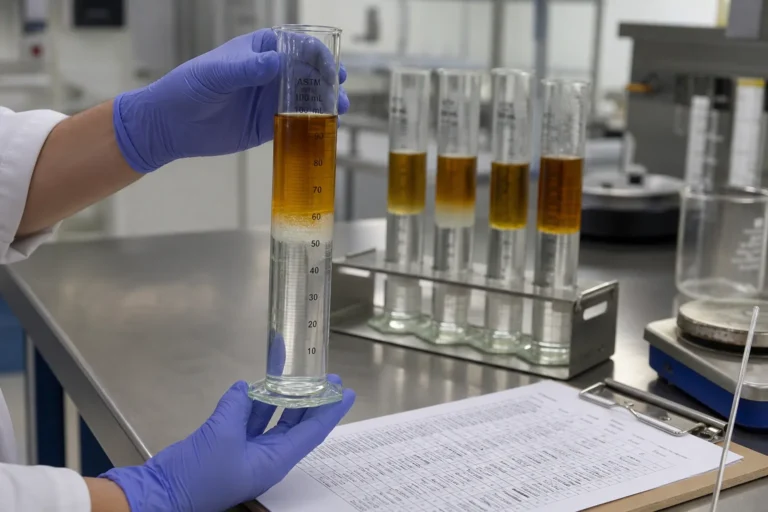
- Industrial lubricant additives are formulation components a blender adds to base oil (75–99% of the finished fluid) so hydraulic, gear, turbine and compressor oils survive years of service.
- Unlike engine-oil chemistry built around combustion, industrial oils prioritise long oxidation life, clean running and water handling.
- Core families: anti-wear/EP, antioxidants (R&O), rust & corrosion control, demulsifiers and antifoam, plus pour-point depressants and tackifiers.
- Choose by the dominant failure mode of the application — pump wear, gear EP load, oxidation life, water release — not by viscosity alone.
- Supplied either as a pre-balanced package or as individual components for full formulation control.
** This session may be vulnerable to “store now, decrypt later” attacks.
Industrial lubricant additives are performance chemicals a blender adds to base oil so hydraulic, gear, turbine and compressor oils survive years of service. The main families are anti-wear and extreme-pressure, antioxidants, rust and corrosion inhibitors, demulsifiers, defoamers and pour-point depressants. Industrial oils are lightly treated — typically well under 1% to about 4% of the finished fluid, versus roughly 10–18% for a passenger-car engine oil package.
What Are Industrial Lubricant Additives?
A finished industrial oil is roughly 75–99% base oil; the rest is a balanced additive system giving properties the base oil can’t provide alone. Unlike an engine oil — built around combustion — an industrial oil is built around long oxidation life, clean running and water handling. With no fuel soot or combustion acid to fight, detergents and dispersants normally aren’t required in industrial gear, turbine or hydraulic oils at all.
They are not the same as a consumer “oil additive” poured into a system; they are formulation components a blender uses to make the finished oil, supplied as a ready package or as individual components.
The Additive Families Used in Industrial Oils
| Additive family | What it does | Typical treat rate | Representative grade + measured value |
|---|---|---|---|
| Anti-wear (ZDDP) | Sacrificial film protects hydraulic pumps | 0.2–5.0% | SPZS-M1: P 7.45% / Zn 9.22% / S 14.82% (D4951) |
| Anti-wear/EP, ashless (zinc-free) | Same role for servo valves and zinc-limited systems | see grade TDS | T9339 (TPPT): P 9.0% / S 9.3%, zero zinc (D4951) |
| Extreme-pressure (sulfur carriers) | Sulfur–phosphorus film carries gear load; safety tracks active sulfur, not total | 1–5% | Sulfurized isobutylene: S 45%, copper corrosion 2e | T3011: active S only 1%, corrosion 1a (D130) |
| Antioxidants (R&O) | Hindered phenols/aromatic amines give turbine, compressor oils multi-thousand-hour life | 0.05–1.5% (phenolic) / 0.1–1% (aminic) | AO135: RBOT 330 min | AO57: 480 min (same D2272 test) |
| Rust & corrosion control | Polar film protects ferrous surfaces; overbased vs. neutral trades reserve for demulsibility | 2–10% (sulfonates) | Overbased barium DNNS TBN 45 vs. B1SA neutral TBN 0.8 (D2896), demulsibility 10 min |
| Metal deactivators | Passivate copper/bronze so EP additives don’t attack yellow metal | 0.02–0.5% | CCI61: S 27.5%, copper corrosion 1A (D130) |
| Water & air management | Demulsifiers shed water; foam/air-release additives keep hydraulics responsive | Demulsifier 0.005–0.02% | Defoamer 0.001–0.05% (ppm) | Demulsifier: 5 min (D1401) | T9000 silicone-free: 20–200 ppm |
| Flow & surface | Pour-point depressants for cold flow; VIIs for viscosity–temperature stability | PPD 0.05–0.5% | VII 1–10% | PPD: 0.5% treat ≈15 °C pour-point drop | Liquid OCP VII: SSI 45/45/26/20 (D6278) |
Treat rates above are typical figures; the confirmed value for any CheMost grade is on its TDS.
From the labSpeccing a hydraulic, gear or turbine oil? CheMost supplies the chemistry.Browse industrial packagesHow Each Family Works
Anti-wear / EP chemistry reacts under load and heat to form a thin sacrificial film on the metal — a phosphate-glass tribofilm from ZDDP, or a sulfide/phosphate film from EP — so asperities shear the film, not the metal. For gears: yellow-metal safety tracks active sulfur, not total — a high-active grade carries more load but risks bronze attack; a low-active grade (~1% vs. 11% total) is the safer default, with a metal deactivator layered on top.
Antioxidants are sacrificial radical scavengers, consumed so the base oil isn’t — which is why oxidation tests (TOST D943, RPVOT D2272) track how long the reserve lasts. For selection: below ~120 °C, hindered phenolics perform best; above it, alkylated diphenylamines take over, and oxidation rate roughly doubles per 10 °C rise — working temperature, not treat rate alone, sets the choice.
Demulsifiers alter the oil–water interface so water coalesces and drops out fast (ASTM D1401); antifoams destabilise surface bubbles. Rust inhibitors form a polar film on steel that water cannot displace (ASTM D665).
How to Choose — by Application, Not by Viscosity
The deciding question is which failure mode dominates, not which oil is “best.” Hydraulic leads on pump anti-wear and fast water release; gearboxes on EP load-carrying and yellow-metal safety; turbines on oxidation life and air/water separation; compressors on oxidation control at hot discharge. The Industrial Oil Selection Matrix maps each application to its lead family and standard; the same logic carries across the industry-by-industry hub.
Why zinc-free grades exist: in 1976, full-load high-pressure piston pumps on zinc hydraulic oil showed heavy bronze piston-shoe wear, traced to thermal breakdown of the ZDDP — the origin of today’s zinc-free grades, still default for servo valves with microns of clearance.
Package or Individual Components?
A ready package is pre-balanced against a named specification — add it to base oil at the stated treat rate for a finished oil. Individual components give full control to fine-tune levels (zinc for servo compatibility, demulsibility, film strength for heavy gears). Start with a package to benchmark, then move to components once validated — full selection logic and all 13 categories in the components catalog. For the engine-oil equivalent of this breakdown — treat rates and component families inside a PCMO/HDDO package — see engine oil additive package components.
FAQ
Are industrial lubricant additives the same as engine oil additives?
No. Engine oil additives are built around combustion (high-TBN detergents, dispersants for soot). Industrial additives prioritise oxidation life, water separation and ashless cleanliness, with EP for gears — a different balance.
What percentage of an industrial oil is additive?
Well under 1% to about 4% overall, versus roughly 10–18% (PCMO) to 14–22% (HDDO) in a finished engine oil — but that single figure hides a spread of about four orders of magnitude by family, from ppm-level defoamer to double-digit VII. The confirmed treat rate for any grade is on its TDS.
What are the big 4 lubricant additives?
There’s no official “big 4” — that framing is usually engine-oil marketing. For industrial oils, the four that decide most failures are anti-wear/EP, antioxidants, rust inhibitors and demulsifiers; which matters most depends on the application.
Which additives go into a hydraulic oil?
Typically a primary-secondary ZDDP or ashless where zinc is restricted, a neutral (not overbased) rust inhibitor, plus demulsifier, antifoam and pour-point depressant. Zinc vs. zinc-free is a system call — see the Industrial Lubricants hub above.
Are metalworking fluid additives the same as industrial lubricant additives?
No — a common mix-up on supplier pages. Metalworking fluids are usually water-based, leaning on sulfonate emulsifiers and low-active-sulfur EP. The industrial lubricants here are oil-based — anti-wear/EP, antioxidants, demulsifiers and defoamers — a different chemistry set for a different job.
Where do I buy them?
CheMost supplies both routes — see the Industrial Lubricants hub for packages by application and the components catalog above for individual grades.
About this guide. Data comes from CheMost’s own datasheets; mechanism and standard references are public (ASTM, ISO, DIN, AGMA) — not CheMost measurements. Where a value isn’t confirmed for a grade, we mark it “on request” rather than estimate. Need a grade sized to your application? Request the full TDS or a sample.
Related Articles
Calcium Sulfonate Grease vs Lithium Complex: Reading the ISO Code
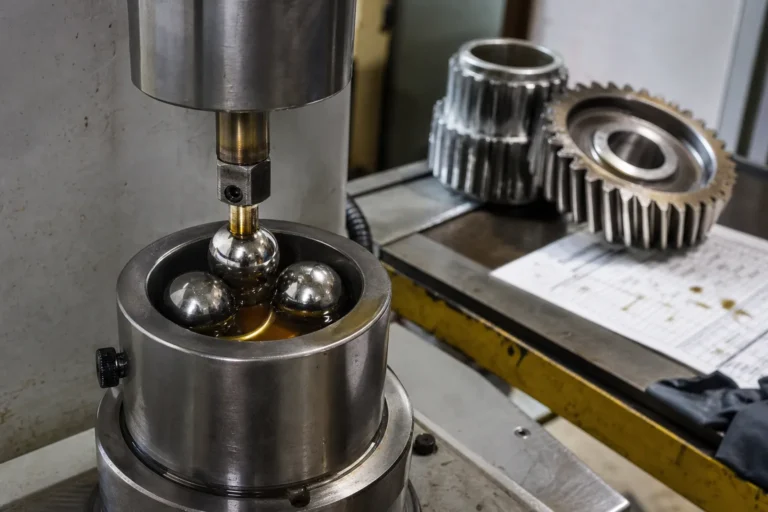
EP vs Anti-Wear Additives: How to Tell Them Apart on a Data Sheet