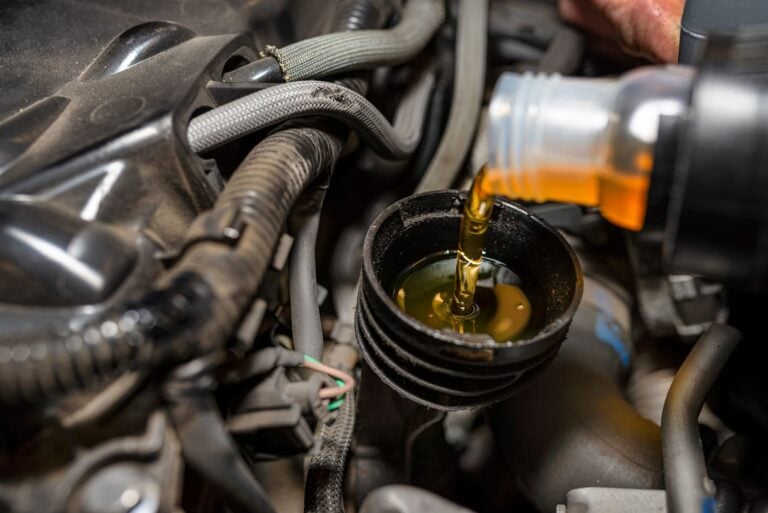
Calcium sulfonate and calcium phenate are the two workhorse overbased detergents in engine oils. The difference sits in the polar head: sulfonates anchor the micelle through a sulfonate (–SO₃) group, phenates through the phenoxide oxygens of a sulfurized, sulfur-bridged alkylphenol. That structural difference sets the TBN ceiling, the oxidation behaviour, and the natural applications of each.
Who this guide is for: blenders, additive buyers, and formulators choosing a detergent system for heavy-duty diesel (HDDO), marine, or gasoline engine oils.
How do calcium sulfonate and calcium phenate compare on paper?
On the datasheet, calcium sulfonate reaches a higher total base number (TBN) at less than half the sulfur, while calcium phenate trades base reserve for sulfur-bridge antioxidancy and much heavier viscosity.
| Property | High-base calcium sulfonate (C300) | Overbased calcium sulfonate (C400) | Overbased magnesium sulfonate (M400) | Sulfurized calcium alkyl phenate |
|---|---|---|---|---|
| TBN (mg KOH/g) | 320 | 415 | 420 | 265 |
| Metal content | 12.5% Ca | 15.85% Ca | 10.0% Mg | 9.85% Ca |
| Sulfur | 1.40% | 1.45% | — | 3.15% |
| Viscosity @ 100 °C (mm²/s) | 45 | 100 | 110 | 250 |
| TDS positioning | Balanced rust + acid control | Maximum base reserve per unit treat | Lower-ash base reserve | High-temperature deposit control + antioxidancy |
What this means for your formulation: matching a finished-oil TBN target with a 265 TBN phenate takes a higher treat rate than a 320–415 TBN sulfonate — and brings over twice the sulfur along, deciding how much sulfur and sulfated-ash headroom is left for ZDDP and the rest of the package.
Why does phenate resist oxidation while high-TBN sulfonate can promote it?
The sulfur bridges in a sulfurized phenate scavenge oxidation intermediates, so the detergent doubles as a mild antioxidant. Sulfonates bring no such functionality — and their carbonated overbase can actually accelerate oil oxidation under severe conditions.
Sequence IIID-era screening data (a long-retired 1970s gasoline-engine oxidation test; single-additive blends, no antioxidant) show the direction: the additive-free test oil thickened ~1,100% in 40 hours, the same oil with overbased calcium sulfonate ~4,900% — with calcium alkyl phenate, only ~300% (Huang Wenxuan, Lubricant Additives [润滑油添加剂]). Read the direction, not the magnitudes.
None of this retires sulfonates: they outperform phenates on solubilization and dispersion, protect against rust — phenates contribute little to none — and cost less. Both chemistries still hand soot control to the dispersant; see how detergents and dispersants split that job.
When a customer package leans on a big slug of overbased sulfonate, the first thing we flag is the oxidation budget: add ashless antioxidant, or bring in phenate as the co-detergent.
Which detergent do marine cylinder oils and HDDO actually run?
Marine cylinder oil is the phenate stronghold — our TDS lists a 25–35 wt% treat rate there, where once-through lubrication must neutralize high-sulfur combustion acids and hold ring-zone deposits. HDDO usually runs the other way: a sulfonate backbone at roughly 2–4 wt% for a finished-oil TBN of 7–10.
Fuel sulfur sets the BN target before chemistry does (background: Chevron’s marine Base Number bulletin). MAN’s service letters span 15–25 BN cylinder oil for fuels at or below 0.10% sulfur, up to BN 100–140+ for HSFO above 0.5% — and warn that when top-land deposits climb on VLSFO, the BN may simply be too high: reduce the feed rate or step down a grade.
Decision rule: start from your fuel sulfur and finished-oil TBN target, then check the arithmetic in a TBN contribution calculator before shortlisting chemistry. Where maximum base reserve per unit treat matters — marine trunk-piston systems, high-sulfur off-road diesel — a 415 TBN overbased calcium sulfonate concentrate is the efficient booster.
From the labFormulating motor oil or transmission fluid? CheMost supplies the chemistry.View engine oil packagesDo you actually have to choose between them?
Usually not. Commercial engine-oil packages typically run sulfonate and phenate in combination for optimum detergency and neutralizing power (Bardasz & Lamb, ch. 19); blended systems also scored well in a published mixture study.
Our default for HDDO work: overbased calcium sulfonate as the TBN backbone, sulfurized phenate as the co-detergent for high-temperature deposits and oxidation control — not either/or. Our own phenate TDS is written up the same way — co-detergent with sulfonate, not rival.
Both routes — plus magnesium and salicylate options — sit in our detergents and TBN boosters range.
Outside the crankcase the same overbased calcium sulfonate takes on a different job: with a little water and a second material it converts into the grease thickener itself, at treat levels far above anything an engine oil sees. That axis is covered separately in calcium sulfonate in grease.
Frequently asked questions
Is this the same calcium sulfonate used in greases?
Same chemistry family, different job. Highly overbased calcium sulfonates are the starting point for calcium sulfonate complex greases, where the carbonate core converts to calcite thickener. This guide covers only the engine-oil detergent role.
Is TBN 400 a sulfonate or a phenate?
Almost always a sulfonate. Commercial sulfurized phenates typically top out around TBN 250–300 — our grade is 265 — while overbased calcium and magnesium sulfonates reach 415–420. A TBN 400 datasheet means overbased sulfonate chemistry — C400 or M400.
Can I swap calcium phenate for calcium sulfonate one-for-one?
No. At TBN 265 versus 320–415 for CheMost calcium sulfonates, matching base reserve alone changes your treat rate, and you lose sulfur-bridge antioxidancy. Rebalance the whole detergent–inhibitor system rather than substituting line for line.
Does a higher TBN detergent always win?
No. TBN is a product-level spec, not a ranking — the same chemistry ships at several TBN grades. Match base reserve to fuel sulfur and drain interval; running more BN than the fuel needs shows up as deposits, not protection.
Where does calcium salicylate fit?
Salicylates are the third route — strong high-temperature detergency with built-in antioxidancy, often run as single-surfactant systems. For low-ash or single-detergent roadmaps, start with our calcium alkyl salicylate.
About this guide. Data comes from CheMost’s own datasheets; mechanism and application claims are cited below. We supply both chemistries and support customer formulation work on request. Deciding between a sulfonate backbone and a phenate co-detergent? Request paired TDS and samples.
References & Industry Standards
- Bardasz, E. A. & Lamb, G. D., “Additives for Crankcase Lubricant Applications,” in Rudnick, L. R. (ed.), Lubricant Additives: Chemistry and Applications, ch. 19.
- Nassar, A. M. et al., “Preparation and evaluation of the mixtures of sulfonate and phenate as lube oil additives,” International Journal of Industrial Chemistry 8, 383–395 (2017).
- Chevron Marine Products, Base Number Technical Bulletin, 2020.
- MAN Energy Solutions, Service Letters SL2019-671 & SL2023-737 (cylinder oil BN guidance).
- 黄文轩 (Huang Wenxuan), 润滑油添加剂 / Lubricant Additives — Sequence IIID viscosity-increase data.
- ASTM D2896, Standard Test Method for Base Number of Petroleum Products by Potentiometric Perchloric Acid Titration.
Related Articles

Calcium vs Magnesium Detergent: Resolving LSPI, Ash Chemistry, and Corrosion in TGDI Formulations