Technical Specifications
| Property | Unit | Typical Value | Test Method |
|---|---|---|---|
| Appearance | — | Yellow, viscous and transparent liquid | Visual |
| Density at 20 °C | kg/m³ | 940 | ASTM D4052 |
| Viscosity at 100 °C | mm²/s | 650 | ASTM D445 |
| Flash Point | °C | 220 | ASTM D93 |
| Acid Value | mgKOH/g | 115 | ASTM D664 |
| Mechanical Impurities | % | 0.02 | ASTM D2276 |
| Water | % | 0.03 | ASTM D1744 |
* Typical values from batch production. Batch-specific COA available on request.
Technical content reviewed by the CheMost additives team · Specifications last reviewed
Molecular Structure
Molecular structure · polymeric W/O emulsifier
Polyisobutenyl succinic anhydride — a polyisobutylene (PIB) chain bearing a succinic-anhydride head group
An amphiphilic polymer: the oleophilic PIB tail dissolves in the continuous fuel/oil phase while the polar succinic-anhydride/acid head adsorbs onto the supersaturated oxidiser droplets — the interfacial film that holds a water-in-oil emulsion explosive together.
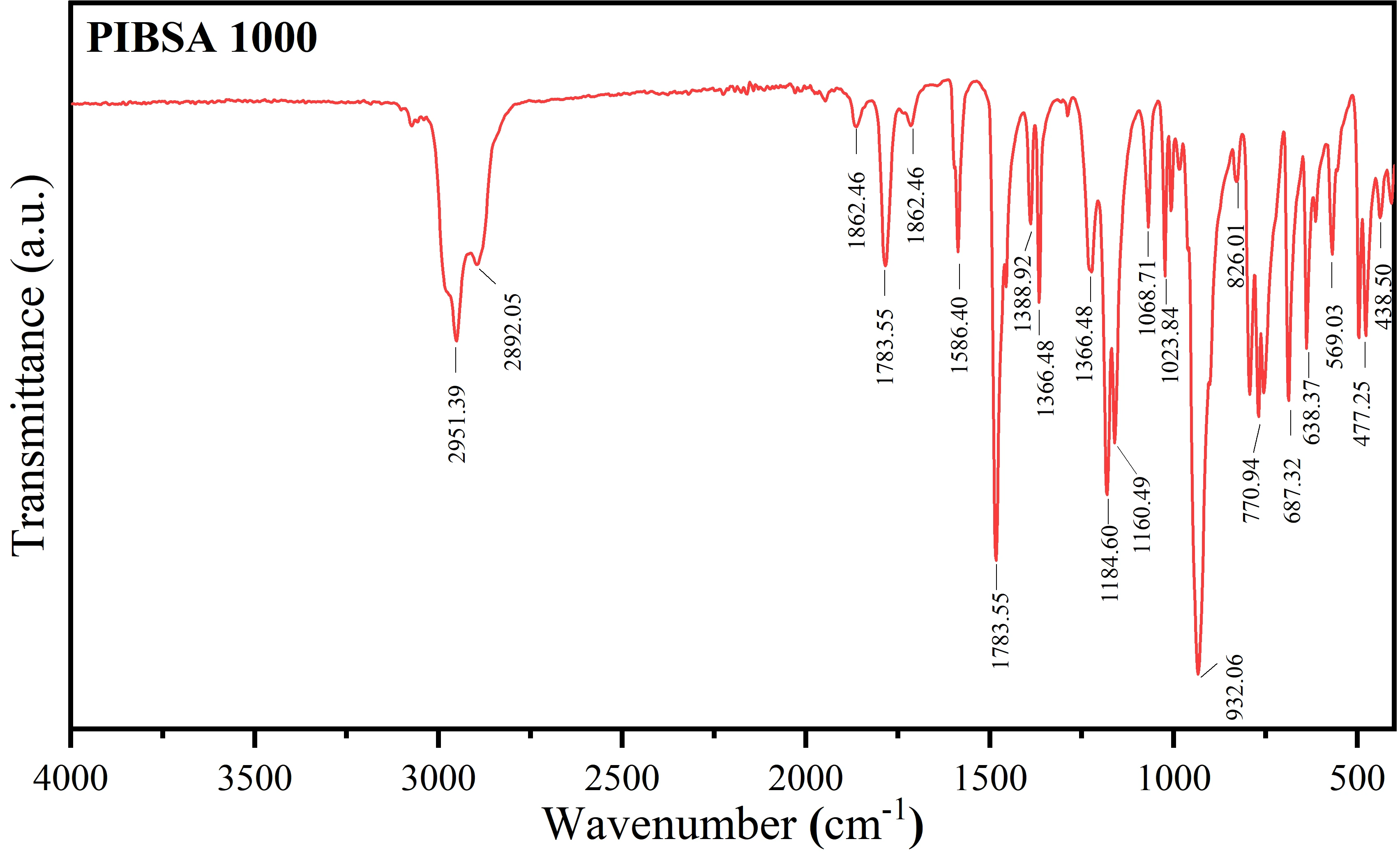
Infrared Spectrum (FTIR)
Fourier-transform infrared (FTIR) spectroscopy records the wavelengths of infrared light a sample absorbs, producing an absorption pattern tied to its functional groups and bonding. Read alongside the acid value and viscosity data above, it gives an independent way to confirm batch identity and consistency.
What Are PIBSA Products for Explosives?
CheMost-PIBSA is a highly active polyisobutylene succinic anhydride (PIBSA) supplied as the primary oil-soluble emulsifier for water-in-oil emulsion explosives — the emulsion matrix used in bulk and packaged blasting agents for mining, quarrying and construction. It is an amphiphilic polymer: a long polyisobutylene (PIB) tail carrying a reactive succinic-anhydride head group, delivered as a yellow, transparent viscous liquid.
The product is made from highly active (high-vinylidene) polyisobutylene reacted with maleic anhydride by a thermal “ene” process rather than a chlorination route. That matters commercially: the thermal route leaves no chlorine and very few by-products, and the chlorine-free character reduces the negative impact that residual chlorine can have on ANFO emulsions. Viscosity and acid value can be customised to a formulator’s process window.
The same PIBSA chemistry has a second life outside blasting — as an emulsifier for metalworking fluids and as the precursor to PIB succinimide dispersants. That lubricant-additive grade is covered on our polyisobutylene succinic anhydride (PIBSA) page; this page is the emulsion-explosives grade, positioned and specified for blasting emulsions.
Looking for PIBSA as a raw material (PIBSA chemical, succinimide precursor)? See our Polyisobutylene Succinic Anhydride (PIBSA) product page, or browse all explosives emulsifiers.
How PIBSA Stabilises an Emulsion Explosive
An emulsion explosive is a water-in-oil (W/O) emulsion: a supersaturated oxidiser-salt solution (largely ammonium nitrate) is dispersed as micron-scale droplets throughout a continuous fuel/oil phase. PIBSA is the surfactant that holds that unstable structure together.
For the mechanism-level view — why the water-in-oil structure holds and how the matrix ages in storage — read our guide on how emulsion explosives work.
Anchored across the fuel/oxidiser boundary
The PIB chain stays dissolved in the continuous fuel phase while the succinic-anhydride/acid head reaches into the supersaturated oxidiser droplets. That reverse-micelle orientation lets a single molecule bridge two phases that would otherwise separate — the defining feature of a water-in-oil surfactant.
Builds a robust interfacial film
By lowering interfacial tension and forming a strong polymeric film around each droplet, PIBSA disperses the supersaturated oxidiser as a fine, uniform emulsion and keeps the two phases from separating.
Resists crystallisation & coalescence
The interfacial film restrains the supersaturated salt from crystallising and the droplets from coalescing — the mechanism behind an emulsion’s storage life, water resistance and detonation reliability. A more robust emulsifier film generally means a longer-lived, more temperature-tolerant matrix.
Chlorine-free for cleaner ANFO emulsions
Because the thermal route leaves no chlorine, the emulsifier avoids introducing chloride into the matrix — the data sheet notes this reduces the negative impact on ANFO emulsions, a practical advantage for heavy-ANFO blends.
How to Select PIBSA Products for Explosives
Emulsion-explosive formulators choose between (and often combine) two emulsifier families. The table sets out the recognised, qualitative trade-offs — not a performance claim on any one product.
| Characteristic | PIBSA (polymeric) | Sorbitan ester, e.g. SMO/Span-type (monomeric) |
|---|---|---|
| Molecular type | High-molecular-weight polymeric surfactant (this page) | Low-molecular-weight monomeric surfactant |
| Interfacial film | Strong, polymeric film — associated with long storage life and temperature tolerance | Thinner film; fast-acting, easy to emulsify |
| Typical role | Primary emulsifier, used standalone or as the backbone of a blend | Often a co-emulsifier to adjust HLB and droplet size |
| Common use | Bulk and packaged emulsions, heavy-ANFO blends | Paired with a polymeric emulsifier to fine-tune a formulation |
In practice the two are complementary: PIBSA can serve as a standalone primary emulsifier or as the polymeric backbone of a blend, with a sorbitan ester added as a co-emulsifier to tune HLB, droplet size and process behaviour. CheMost-PIBSA’s customisable viscosity and acid value let a formulator match it to an existing process line.
Applications
CheMost-PIBSA is used as the water-in-oil emulsifier in formulations targeting the emulsion-explosive duties below:
Bulk emulsion explosives
The primary use: emulsifier for pumped or augered bulk emulsions loaded on-bench for surface and underground metal mining, coal and hard-rock blasting.
Packaged emulsion explosives
Cartridged, chub and paper-wrapped emulsion products for development headings, tunnelling and applications where a detonator- or booster-sensitive packaged charge is used.
Heavy-ANFO / emulsion blends
The emulsifier phase in emulsion-and-ANFO blends, where its chlorine-free character is an advantage for matrix quality in the finished blend.
Quarrying & construction blasting
Aggregate quarries, cement/limestone operations and civil construction blasting that rely on stable, water-resistant emulsion matrices.
CheMost-PIBSA is an emulsifier raw material. The classification, UN transport number, licensing and detonation performance of a finished emulsion explosive belong to the fully formulated product and its manufacturer, not to an individual emulsifier component.
Treat Rate
The data sheet specifies the emulsifier but not a per-formulation dosage, so the figure below is indicative — derived from the chemistry and general industry practice — and must be confirmed on your matrix and process.
Indicative level. In a water-in-oil emulsion explosive the emulsifier is a small but decisive fraction of the matrix — typically on the order of ~1–2 wt% of the emulsion, sitting within the fuel phase (itself usually a few percent of the emulsion). The exact level is set by the oxidiser/fuel ratio, the target droplet size, storage time and temperature, and whether PIBSA is used standalone or with a sorbitan-ester co-emulsifier.
More emulsifier is not automatically better: emulsion stability is a balance of interfacial chemistry, droplet size and phase ratio, and over-dosing changes viscosity and cost without improving matrix life. The right level is optimised on the finished emulsion.
Treat rates are indicative starting points, not fixed dosages. CheMost-PIBSA is one component of the emulsion system; the final level must be confirmed against your formulation, process and storage requirements. CheMost can provide formulation and emulsion-stability support on request.
Formulating With PIBSA — Complementary Components
Sorbitan-ester co-emulsifiers
A monomeric sorbitan ester (SMO / Span-type) is often paired with PIBSA to tune the HLB, droplet size and refinement of the emulsion — the polymeric backbone plus a fast monomeric surfactant.
The fuel / oil continuous phase
PIBSA dissolves in the continuous fuel phase (mineral oil, wax or diesel), where its PIB tail anchors while the anhydride head reaches into the oxidiser droplets. The choice of fuel phase and the emulsifier work together.
The oxidiser phase
The dispersed phase is a supersaturated ammonium-nitrate-based oxidiser solution. The emulsifier’s job is to hold that supersaturated solution as stable droplets; matrix design and gassing/sensitisation are the formulator’s domain.
The same chemistry, other markets
The identical PIBSA amphiphile is used as a metalworking-fluid emulsifier and as a PIB-succinimide dispersant precursor — see the lubricant-grade PIBSA page for those applications.
Documentation, Qualification & Regulatory Support
Standard documentation — Certificate of Analysis (COA, per shipment), Technical Data Sheet (TDS) and Safety Data Sheet (SDS, GHS/CLP) — is provided. The full TDS is available on request rather than as a public download. Additional support is available on request:
Regulatory documentation
REACH, TSCA and country-specific market-registration documentation support available on request.
Third-party inspection
SGS / Intertek / BV pre-shipment inspection can be arranged on request.
Custom grades & packaging
Customisable viscosity and acid value, and drum / IBC / ISO-tank packaging, on request.
Formulation support
Emulsion-stability and treat-rate guidance for your matrix from our technical team.
Packaging & Supply
CheMost-PIBSA is stocked and shipped worldwide, with a typical lead time of 1–15 days and a 36-month shelf life at ambient temperature. Store below 50 °C; the maximum blending temperature is 70 °C. Samples and quotations are answered within 12 hours.
Packaging
170 kg metal drum · 900 kg IBC tank · ISO tank.
Minimum order
By drum or IBC — contact us for your quantity.
Incoterms
FOB · CIF · EXW, to suit your freight arrangement.
Loading ports
All major Chinese ports.
Frequently Asked Questions
What is PIBSA and why is it used in emulsion explosives?
PIBSA (polyisobutylene succinic anhydride) is an oil-soluble, amphiphilic polymer made by reacting highly active polyisobutylene with maleic anhydride. In an emulsion explosive it is the water-in-oil emulsifier: the PIB tail sits in the fuel phase while the succinic-anhydride head anchors the supersaturated oxidiser droplets, holding the emulsion matrix together and giving it storage life and water resistance.
Why does “chlorine-free” matter for ANFO emulsions?
Older PIBSA routes use chlorine and leave residual chloride behind. CheMost-PIBSA is made by a thermal process from highly active PIB, so it is chlorine-free with very few by-products. According to the data sheet, that chlorine-free character reduces the negative impact on ANFO emulsions — useful for matrix quality in heavy-ANFO blends.
Can PIBSA be used as a standalone emulsifier or with a co-emulsifier?
Both. As a polymeric primary emulsifier it can be used on its own or as the backbone of a blend, and it is commonly paired with a monomeric sorbitan ester (SMO / Span-type) co-emulsifier to fine-tune HLB, droplet size and process behaviour. The best combination depends on your matrix and equipment.
What does the acid value of 115 mean?
In an emulsion explosive the acid value (115 mgKOH/g, ASTM D664) measures how many succinic-anhydride/acid head groups are available to anchor at the oxidiser-droplet interface — in effect, how much emulsifying “grip” the polymer carries per unit mass. Formulators read it alongside viscosity to match the emulsifier to their matrix and process line; both can be customised on request.
How is it supplied, and how much is used?
It is supplied as a yellow viscous liquid in 170 kg metal drums, 900 kg IBCs and ISO tanks, with a 36-month shelf life. As the emulsifier it is typically on the order of ~1–2 wt% of the emulsion, set by the oxidiser/fuel ratio, droplet-size target and storage requirements; the exact level is confirmed on your matrix. Samples and quotations are answered within 12 hours.