Lubricant Additive Components
CheMost supplies antifoam additives and defoamers for lubricants — the surface-active components that break and suppress foam and help oil release entrained air in hydraulic, gear, turbine, compressor and metalworking fluids.
These are industrial foam-control additives dosed into finished oils and additive packages — not the consumer “defoamer” bottles sold for hot tubs or pools. The range covers the three workhorse non-aqueous routes: silicone (PDMS), non-silicone polyacrylate, and silicone-free. Compare them below, then open a product page for specifications and documentation.
Browse CheMost Foam Inhibitors & Defoamers
Start with the product family that best matches your formulation target. Each product page goes deeper into the exact grade, properties, and documentation.

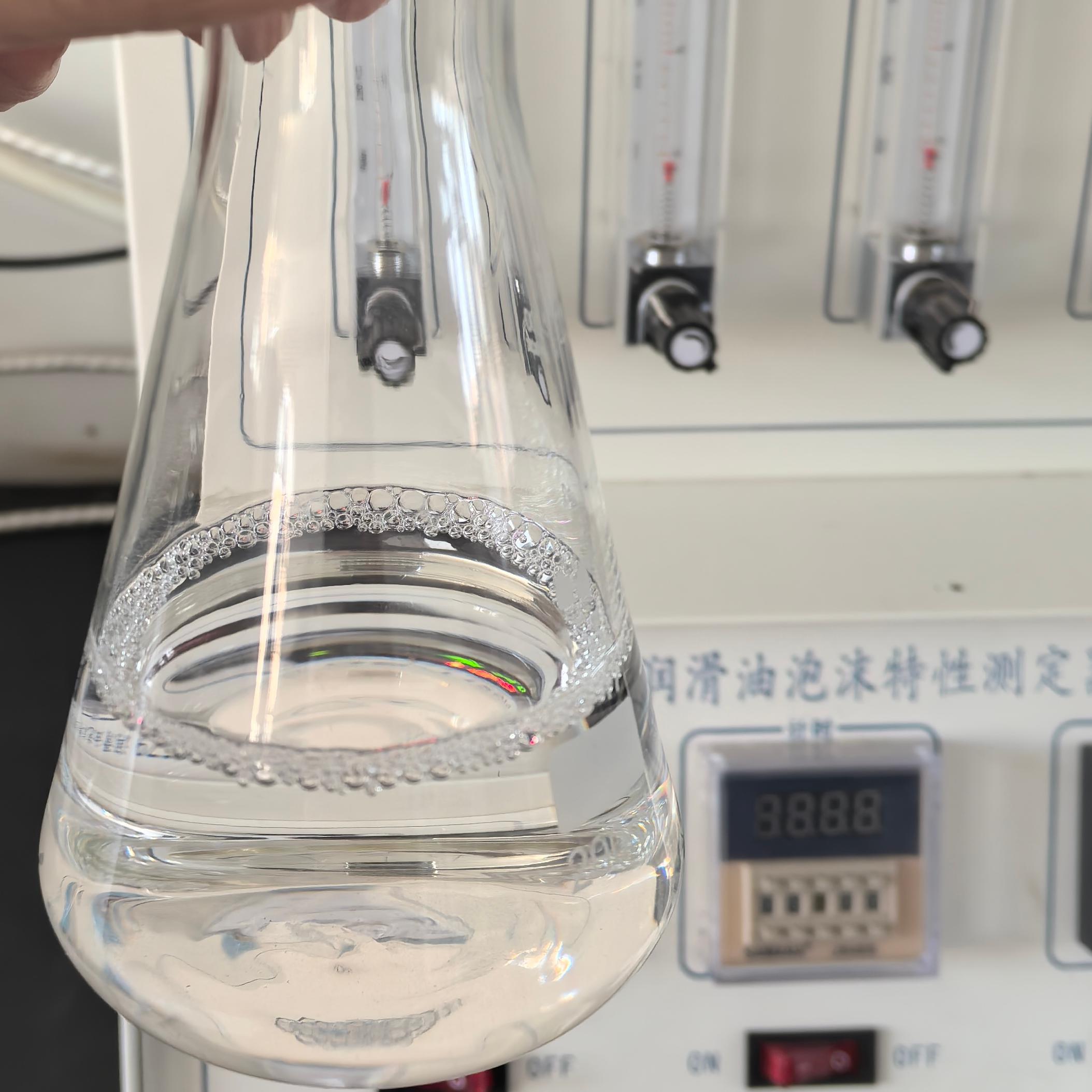

Why Foam and Entrained Air Matter
Most lubricant systems agitate the oil and pull in air. The air shows up two ways — as surface foam (a bubble layer on top of the oil) and as entrained air (fine microbubbles suspended in the bulk oil). Both are damaging: in gear oils, hydraulic fluids and metalworking fluids they cause pump cavitation, noisy and spongy control response, pressure spikes, higher running temperatures and accelerated oil oxidation. High-viscosity oils make it worse — they trap fine, slow-draining bubbles — and surface-active additives such as detergents and dispersants raise the foaming tendency, so a finished oil almost always needs a foam-control additive.
Defoaming Is Not the Same as Air Release
This distinction drives correct additive selection, and it is the first question to settle:
- Surface foam → a defoamer / antifoam. The additive reaches the foam film, spreads at the air–oil interface with its lower surface tension, and displaces the surfactants that stabilise the bubble so the film ruptures.
- Entrained air / microfoam → air release. Here the job is to help tiny suspended bubbles coalesce and migrate to the surface and escape. An additive that is excellent at knocking down surface foam is not automatically good at air release — in fact a strongly incompatible silicone can suppress surface foam yet slow air release.
A good foam-control additive works through controlled incompatibility: it must be insoluble enough to migrate to the foam film, but not so incompatible that it causes haze, cratering or filtration problems. Getting that balance right for your base oil is the core of selection.
The CheMost Range — How to Choose
CheMost covers the three non-aqueous foam-control routes. Match the chemistry to your base oil, air-release requirement and silicone tolerance:
Polydimethylsiloxane (PDMS) Silicone Defoamer
Grade: G1000 (silicone / PDMS).
Best for: Maximum surface-foam knock-down at very low (ppm) treat — the most efficient macrofoam route for mineral and many synthetic oils.
Trade-off: Can reduce air release and needs good dispersion/compatibility control; avoid where downstream silicone is a problem (e.g. paint shops).
Acrylate (Polyacrylate) Foam Inhibitor
Grade: T9100 / T9200 (acrylate compound, trace PDMS).
Best for: A balance of foam control and low impact on air release — hydraulic and gear oils where deaeration matters; T9200 is tuned for sulfonate-containing oils.
Silicone-Free Compound Foam Inhibitor
Grade: T9000 (silicone-free compound).
Best for: Systems that must be silicone-free for compatibility, paint/coating wetting or filtration reasons, where a silicone defoamer cannot be used.
Treat Rate & Dosing
Foam-control additives are very low treat-rate, high-impact components — silicone defoamers are typically dosed at only a few to tens of parts per million (industry examples for PDMS sit around 10–20 ppm), while non-silicone polyacrylate types are usually used at somewhat higher levels. Two rules matter:
- More is not better. Overdosing can reverse the effect, hurt air release and cause haze or filter blocking. The goal is to control foam while preserving filtration, deaeration and clarity — not simply to add the strongest defoamer.
- Validate by bench test. Foam control is read with standard methods — ASTM D892 (foaming tendency and stability), ASTM D6082 (high-temperature foam) and ASTM D3427 (air release). A pass on foam tendency at a given dose does not guarantee air release is optimised, so both are checked.
Exact dose depends on your base oil, the rest of the additive package and your foam/air-release targets. CheMost can advise on grade and starting treat rate on request.
Common Applications
- Hydraulic fluids: entrained air degrades control precision and pump stability — air release is as important as surface-foam control here.
- Industrial & automotive gear oils: high agitation and air entrainment amplify foam; foam control protects the load-bearing film.
- Turbine & compressor oils: long-life circulating oils where fast air release and stable low foam are essential.
- Metalworking fluids: surface foam and microfoam affect machining visibility, pump feed and finish; non-silicone routes are often preferred.
- Engine & transmission oils: detergent/dispersant-rich packages foam readily and rely on a foam inhibitor to pass foam-sequence requirements.
Need help selecting a foam-control additive?
Tell us your base oil, whether you are fighting surface foam or entrained air, your silicone tolerance and the foam/air-release target. We will point you to the right grade — silicone, polyacrylate or silicone-free — then share the relevant technical documents.
Request a Sample Get a QuoteFoam inhibitors are specified across Automotive Lubricant and Industrial Lubricant formulations, alongside antioxidants and viscosity index improvers. See our industry pages for a full overview of the additives used in each application.
Quick Reference
What is an antifoam additive (defoamer)?
It is a surface-active additive dosed into a lubricant to break and suppress foam. It spreads at the air–oil interface, lowers surface tension locally and displaces the surfactants that stabilise the bubble film so it ruptures. In lubricants it is used at very low (often ppm) treat rates and is essential because agitation and additives like detergents make finished oils foam.
What is the difference between a defoamer, an antifoam and an air-release agent?
“Antifoam” and “defoamer” are used interchangeably for additives that suppress or break surface foam. Air release is a separate function — helping fine entrained microbubbles in the bulk oil coalesce and escape. An additive can be excellent at surface foam yet poorer at air release, so the first step is deciding which problem you are solving.
Silicone or non-silicone — which should I use?
Silicone (PDMS) gives the highest surface-foam efficiency at the lowest treat, but can reduce air release and is unwanted where downstream silicone causes problems. Non-silicone polyacrylate types balance foam control with good air release and avoid silicone issues. Use a silicone-free grade where the system must contain no silicone. CheMost supplies all three routes.
How much foam inhibitor should I add?
Very little — silicone defoamers are often dosed at only ~10–20 ppm, polyacrylate types somewhat higher. More is not better: overdosing can worsen air release and cause haze or filtration problems. Validate the level with ASTM D892 (foam) and ASTM D3427 (air release) on your actual oil; our team can suggest a starting dose.
Are these the same as a hot-tub or pool defoamer?
No. CheMost supplies foam-control additives for lubricant and industrial-fluid formulators — silicone, polyacrylate and silicone-free types for oils — in drums and IBCs. These are raw additive components for oil blenders, not the consumer aftermarket defoamer products sold for hot tubs, pools or laundry.
Explore Other Additive Components
Every CheMost additive component, at a glance. Build a complete formulation — open any family to see its full product range, grades, and treat rates.