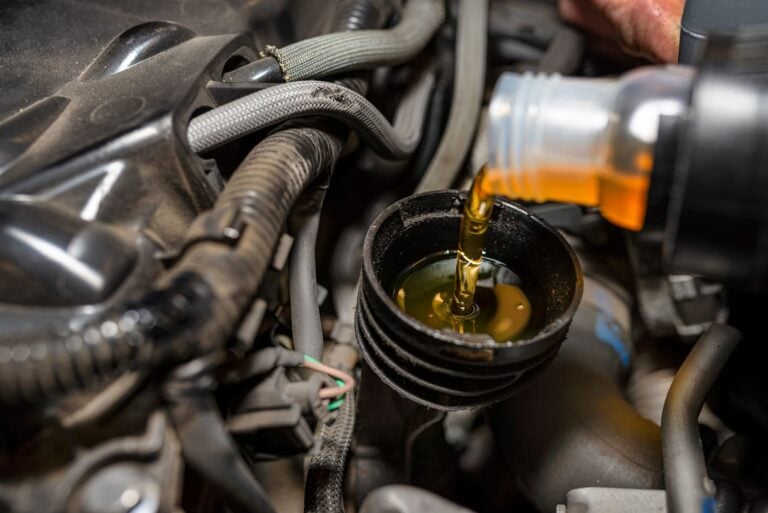
- A viscosity index improver (VII) is a polymer that reduces how much an oil's viscosity changes with temperature — what makes multigrades such as 5W-30 and 10W-40 possible.
- Viscosity index is a dimensionless number (ASTM D2270) from KV at 40°C and 100°C: mineral oils ~95–105, PAO 140–150, finished oils with a VII 160–200+.
- VIIs work by coil-and-stretch — coiled and low-impact when cold, expanded and thickening when hot.
- Judge a VII on thickening efficiency (TE), shear-stability index (SSI, ASTM D6278) and HTHS contribution.
- Four chemistries: OCP (low-cost mainstream), PMA (low-temp + pour-point depressant), HSD (high-TE premium) and PIB (thickener / dispersant-VII base).
- Mechanical shear permanently breaks chains, so specs set post-shear KV100 minimums (API SP requires ≥9.3 cSt for a 5W-30).
A viscosity index improver (VII), or viscosity modifier, is an oil-soluble polymer that reduces how much an oil thins as it heats up — the effect that makes multi-grade oils such as 5W-30 possible. Its coils stay compact when cold and expand when hot, adding viscosity exactly where the base oil loses it.
For a formulator, choosing a VII is a balancing act: you cannot maximise thickening efficiency, shear stability and low cost at the same time. The right grade depends on the shear stability (SSI) your specification demands, the HTHS and viscosity-index targets you must hit, the low-temperature and deposit risks you must avoid, and the real datasheet numbers behind each polymer. This guide works through all four.
Who this guide is for: lubricant formulators, blenders and technically-minded buyers selecting a viscosity modifier grade — not a one-line definition.
What does a VII do — and the trade-off you can’t escape?
A VII adds almost no viscosity when the oil is cold and a lot when it is hot. That temperature-dependent thickening lets a thin, easily-pumped base oil behave like a much thicker oil at operating temperature — the whole basis of a multi-grade.
The mechanism is a coil that expands and contracts with temperature: at low temperature the polymer is poorly soluble and contracts into a compact coil that barely affects flow; as temperature rises it dissolves, the coil swells, and it donates more and more viscosity index. Simple enough — but it sets up a trade-off you cannot design your way out of. Thickening efficiency comes from high molecular weight, and high molecular weight is exactly what mechanical shear breaks. The most shear-stable, most efficient polymers also cost the most. You get to optimise two of the three — thickening efficiency, shear stability, cost — and the third is your compromise.
Why this matters: there is no universally “best” VII, only the best fit for your SSI budget, your VI/HTHS target and your cost ceiling. Everything below is about placing that compromise deliberately rather than by accident.
Shear stability (SSI): the number that decides your VII
If you take one number from this guide, take the shear stability index. SSI is the fraction of the viscosity a polymer contributes that is lost after the oil is mechanically sheared (ASTM D6278, the Kurt Orbahn injector test) — so a lower SSI means a more shear-stable polymer, and commercial olefin-copolymer VMs run an SSI of roughly 23–55.
The distinction that trips people up is temporary versus permanent loss. Under high shear the polymer coil stretches and the oil thins — but that temporary viscosity loss reverses once the shear stops. Permanent viscosity loss is different: the polymer chain actually ruptures, and the viscosity never returns to what you blended. Permanent loss is what drops your oil out of grade. A useful rule from the “viscosity-loss trapezoid”: chain scission lowers both KV and HTHS permanently, but the KV loss is always the larger of the two.
How low an SSI you need is set by the application, not by preference:
- SSI ≤ 25 — typical for European diesel and gasoline oils
- SSI ≤ 35 — preferred for North American diesel formulations
- SSI ≈ 55 — the lowest shear stability generally acceptable for modern engine oils
Shear thinning can cost an oil an entire viscosity grade. An oil blended to 5W-30 with too high an SSI can shear toward a 5W-20 in service — losing film thickness before the drain. This is why modern specs set a minimum KV100 after a standardised shear test, not just for fresh oil.
The takeaway for blenders: match SSI to the duty and the drain interval, not to the cheapest polymer. A long-drain heavy-duty oil or a hard-sheared driveline fluid needs a low-SSI, shear-stable grade to stay in grade; a short-drain passenger-car oil can tolerate more. Independent shear-test detail (Kurt Orbahn, sonic and the more severe KRL tapered-bearing test) is covered well by Savant Labs.
OCP, PMA, HSD or PIB — matching chemistry to your oil
Four polymer families cover almost all commercial VIIs, and each sits at a different point on the efficiency–shear–cost–low-temperature map. Below is how they compare, with representative values from CheMost’s own grades where we supply them:
| Chemistry | Thickening efficiency | Shear stability | Low-temp / notes | CheMost grade |
|---|---|---|---|---|
| OCP (olefin copolymer) | High | SSI 20–45 (commercial 23–55) | Good if ethylene ≤ ~60%; low cost; dominant multigrade VM | Liquid OCP viscosity modifier (SSI 20–45) |
| EPM (ethylene-propylene) | High | SSI 23 | Solid base polymer, dissolved by the blender; 51.5% ethylene | EPM base polymer (SSI 23) |
| PMA (polymethacrylate) | Lower (~15% of MW in backbone vs 80–90% for OCP) | Good | Excellent low-temp; also a pour-point depressant; higher cost | PMA (dual VII / pour-point depressant) |
| HSD (hydrogenated styrene-diene, star) | Very high | Good, but more permanent loss than OCP at the same nominal SSI | Excellent low-temp; premium fuel-economy oils | — |
| PIB (polyisobutylene) | Low VI lift | — | Base for dispersant-VII multifunctionals | — |
OCP earns its dominant market position on high thickening efficiency and low cost. Ethylene content is the lever: above ~60% ethylene it becomes a low-temperature OCP (LTOCP), but push it too high and crystallinity hurts low-temperature pumpability. PMA is, counter-intuitively, a less efficient thickener than OCP despite its high molecular weight — only about 15% of a PMA’s mass sits in the backbone (versus 80–90% for an olefin polymer), giving a shorter end-to-end coil. What PMA gives back is low-temperature performance and a bonus: its long-chain (C14+) segments interact with wax, so it doubles as a pour-point depressant. HSD star polymers offer very high efficiency and good shear stability but take more permanent loss under severe duty. PIB lifts VI little and is mainly a backbone for dispersant-VII multifunctionals.
- Cost-efficient multigrade thickening leads
- You must hit HTHS ≥ 3.5 cP
- PCMO / HDDO engine oils
- Low-temperature rheology is critical
- ATF, gear oils, energy-conserving oils
- You want VII + pour-point depression in one additive
What this means for you: lead with OCP (or an EPM base polymer) for economical, HTHS-friendly multigrade thickening; move to PMA where cold-flow or a dual VII/PPD function matters. One caution: OCP and PMA blends give useful intermediate properties, but a concentrated physical mixture of the two is incompatible — combine them at the finished-oil level, not in concentrate. Browse the full CheMost viscosity index improver range for grade options. For the polymer-class background, STLE’s report on VI improvers is a good neutral reference.
From the labFormulating motor oil or transmission fluid? CheMost supplies the chemistry.View engine oil packagesMatching the VII to your spec: VI, HTHS and SAE J300
A VII is not chosen in isolation — it has to deliver the finished oil’s viscosity index and HTHS within an SAE J300 grade. Your starting point is the base oil: API Group I and II stocks have a VI of 80–120, Group III and PAO (Group IV) exceed 120, and a VII then lifts a finished multigrade to roughly 150–200+.
SAE J300 grades an oil two ways at once: the “W” (winter) grade is set by cold-cranking and pumping viscosity, the non-W grade by kinematic viscosity at 100 °C and by HTHS viscosity at 150 °C and 10⁶ s⁻¹. A multigrade such as 5W-30 must satisfy both. HTHS is frequently the binding constraint: many European OEMs specify a minimum HTHS of 3.5 cP irrespective of grade, and it is easier to hold above 3.5 cP with an OCP than with a lower-HTHS polymer.
Published data for SAE 5W-30 oils blended with olefin-copolymer VMs shows how little polymer is actually needed:
KV100 ≈ 10 cSt
OCP polymer content = 0.58–1.05 wt%
HTHS (150°C) = 2.88–3.07 cP
In practice: fix your W grade and HTHS target first, then choose the lowest-cost polymer that meets your SSI ceiling at that treat rate. You can size the finished VI from your base-oil and blend viscosities with our viscosity index calculator, or tell us your target grade, HTHS and SSI limit and we’ll recommend a VII grade and treat rate — request a sample or the full TDS → (The governing grade limits are set by SAE J300.)
Formulation cautions
A few failure modes catch formulators moving between VII grades:
- High-ethylene OCP and low temperature: ethylene raises thickening efficiency but, above ~60%, crystallinity can hurt low-temperature pumpability and contribute to sludge. Balance ethylene against your cold-flow target.
- Soot and deposits: a dispersant-VII (DVII) builds soot handling and deposit control into the viscosity modifier itself — worth considering for diesel oils rather than adding dispersant and a plain VII separately.
- OCP + PMA incompatibility: the two give useful intermediate rheology in the finished oil, but a concentrated physical mixture is incompatible — never pre-blend the concentrates.
- Over-treating: more polymer is not more performance. Past its optimum a pour-point depressant gives only marginal gains and can even cause pour-point reversion; the same discipline applies to VII treat rate and the phosphorus, HTHS and cost budgets it shares with the rest of the additive package.
Viscosity index improver FAQ
OCP or PMA — which viscosity modifier should I use?
Use OCP (or an EPM base polymer) as the default for cost-efficient multigrade thickening and where you need HTHS ≥ 3.5 cP — it dominates the engine-oil VM market for good reason. Choose PMA where low-temperature rheology is critical (ATF, gear oils, energy-conserving oils) or where you want viscosity improvement and pour-point depression in a single additive. Many premium oils blend both at the finished-oil level.
What is a good HTHS number, and is lower better?
It depends on the duty. Many European and heavy-duty OEMs require a minimum HTHS of 3.5 cP for bearing durability, so “good” there means ≥ 3.5 cP. Lower HTHS (down to the SAE 16 grade’s 2.3 mPa·s) improves fuel economy but reduces the hydrodynamic margin protecting bearings — so lower is “better” only up to the point your engine’s durability requirement allows.
How much viscosity does an oil lose from shear — can it drop a grade?
Yes. Permanent viscosity loss from polymer chain scission is irreversible and can move an oil down an entire viscosity grade — a 5W-30 shearing toward a 5W-20. How much depends on the VII’s shear stability index: a low-SSI, shear-stable grade holds its grade over long drains and hard-sheared duty, while a high-SSI grade can shear out of grade before the next oil change.
What is the difference between KV40, KV100 and HTHS viscosity?
KV40 and KV100 are kinematic viscosities (in cSt) at 40 °C and 100 °C under no external shear (ASTM D445), and the two together give the viscosity index (ASTM D2270). HTHS is high-temperature high-shear viscosity measured at 150 °C and 10⁶ s⁻¹ (ASTM D4683), which simulates an operating engine bearing. HTHS is a better predictor of bearing protection than KV100 alone and is increasingly the specification target.
Can I add a VII directly to base oil to make a multigrade?
Technically it thickens the oil and raises its VI, but a finished lubricant needs a full additive package — antiwear (such as ZDDP), detergent, dispersant, antioxidant. A VII alone gives a more thermally stable oil without the performance chemistry a specification requires. VII is always one component of a balanced formulation.
Do viscosity index improvers cause sludge?
They can if mismatched. Olefin copolymers with too high an ethylene content can crystallise at low temperature and contribute to sludge, which is why modern OCPs balance ethylene around 50–60%. Polymethacrylate VIIs are inherently more resistant to this. Grade selection, not the polymer class alone, decides the outcome.
About this guide
This guide was written by the CheMost additives formulation team, drawing on the tribology and lubricant literature (STLE, Savant Labs, and Stambaugh’s chapter in Chemistry and Technology of Lubricants), the ASTM, SAE and API standards cited throughout, and CheMost’s own product datasheets. CheMost has supplied lubricant additives since 2013, with REACH and TSCA documentation support and third-party (SGS/Intertek/BV) inspection available on request. It is intended for formulators and blenders; it is not an OEM approval, and finished-oil performance claims belong to the finished oil.
Need a VII grade at the right SSI for your spec? We supply OCP, EPM and dual-function PMA grades with full TDS and rapid samples, and support your broader lubricant additive components selection. Request a sample or the full TDS →
Related guides
- Engine oil additive package components — where the VII sits in the full pack.
- What is ZDDP? — the antiwear additive the VII shares the phosphorus and cost budget with.
References & industry standards
- Canter, N. “Viscosity Index Improvers.” STLE Tribology & Lubrication Technology, Sept 2011. stle.org
- “Testing Shear Stability and Viscosity Loss.” Savant Labs (independent test laboratory). savantlab.com
- Mathura, S. “Viscosity Index Improvers Explained.” Precision Lubrication, 2024. precisionlubrication.com
- Stambaugh, R.L. “Viscosity index improvers and thickeners,” in Chemistry and Technology of Lubricants (Springer, 1992). link.springer.com
- Standards referenced: ASTM D2270 (VI), ASTM D445 (kinematic viscosity), ASTM D6278/D6022 (shear stability), ASTM D4683 (HTHS); SAE J300; API Base Oil Groups.
Related Articles
Calcium Sulfonate vs Calcium Phenate: Which Detergent Does Your Formulation Need?
Engine Oil Additive Package Components: What’s Inside Your Oil